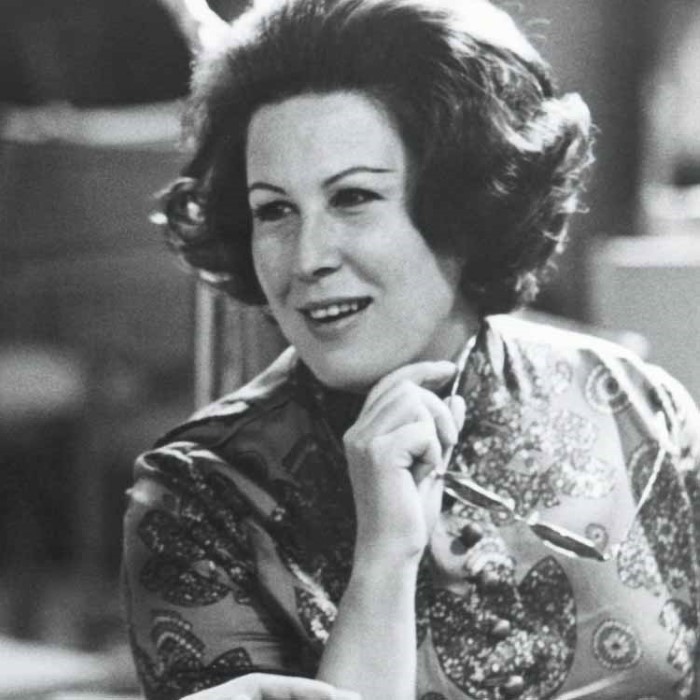
Overview
Expanded performer profile.
Artistic identity
A soprano of extraordinary purity, suspended legato and unmistakable radiance, central to post-war Mozart, Strauss, Bach and the Karajan recording legacy.
Historical position
The profile connects institutions, repertoire, recordings and reception across the complete career.
Extended biography
Extended biography.
Born in Berlin on 2 August 1937 and raised in Graz, Janowitz studied at the Graz Conservatory. Herbert von Karajan recognised her exceptional quality early and engaged her for Barbarina in Le nozze di Figaro at the Vienna State Opera in 1959; she became a permanent member in 1962.
The voice was immediately distinctive: pale-gold rather than dark, exceptionally even, with a floating upper register and a controlled vibrato that could make sustained phrases seem almost instrumental. This made her ideal for Mozart, Bach, Haydn and the more lyrical regions of Strauss and Wagner.
Her 1960s career expanded through Bayreuth, Salzburg, Glyndebourne, Berlin and the Metropolitan Opera. At the Met she debuted as Sieglinde in 1967, demonstrating that her apparently delicate timbre could carry Wagner when the orchestral and dramatic conditions were intelligently balanced.
Mozart roles—Pamina, Fiordiligi, Donna Anna and the Countess—formed one centre of her stage identity; Strauss roles such as Ariadne and the Marschallin formed another. Her Vienna Marschallin alone reached 42 performances between 1978 and 1990.
Janowitz was equally important in concert and Lied. Bach, Haydn, Beethoven, Brahms, Schubert and Richard Strauss were recorded with conductors including Karajan, Böhm, Klemperer, Jochum, Bernstein, Kubelík and Solti.
She left the operatic stage in 1990 as Ariadne in Vienna and continued recital activity before retiring from performance. Her discography remains a primary document of the Central European post-war sound ideal: long line, tonal purity, orchestral integration and disciplined restraint.
Career
Career phases.
Repertoire
Core repertoire.
Mozart
Pamina, Fiordiligi, Donna Anna and Countess define her classical operatic legacy.
Richard Strauss
Ariadne, Marschallin and Four Last Songs exploit the suspended legato.
Wagner
Sieglinde and selected Wagner demonstrate lyrical projection rather than sheer weight.
Sacred & concert
Bach, Haydn, Beethoven and Brahms are central to her recorded identity.
Lieder
Schubert and Strauss reveal her exceptional control of sustained line and colour.
Interpretive style
Interpretive style.
Purity
An unusually clean, luminous tone with little grain.
Legato
Phrases seem suspended on a continuous stream of breath.
Controlled vibrato
Pitch centre remains exceptionally clear.
Restraint
Expression emerges through colour and line rather than overt theatricality.
Technique, practice & influence
Technique, practice and influence.
Breath continuity
Long arcs depend on exceptionally stable support.
Vowel alignment
Resonance remains consistent across registers.
Dynamic suspension
Soft singing retains core and projection.
Influence
She became a reference point for Mozart, Strauss and orchestral soprano singing.
Recordings & audio legacy
Recordings and audio legacy.
Karajan legacy
DG and EMI recordings form a major part of her public identity.
Mozart
Figaro, Così and related recordings preserve her classical style.
Strauss
Four Last Songs and operatic recordings are among her most influential documents.
Sacred music
Bach, Haydn, Beethoven and Brahms show orchestral integration and line.
Schubert Lieder
Recitals demonstrate a less public but equally important textual art.
Documents & sources
Research pathways.
Performance archives
Opera-house records, programmes and broadcasts establish chronology.
Recorded evidence
Commercial and live recordings provide direct evidence of style and vocal development.
Research & legacy
Research and legacy.
Vienna archives
Role histories permit precise reconstruction of her stage development.
Karajan collaboration
Sessions and performances illuminate conductor-singer aesthetics.
Acoustic profile
Her low-grain timbre and vibrato invite spectral and historical comparison.
Opera vs Lied
Contrasting recordings show how the same vocal economy served different genres.
Chronology
Detailed dated chronology.
Born in Berlin and later raised in Graz.
Karajan engages her as Barbarina in Le nozze di Figaro.
Begins appearances associated with the festival era.
Becomes a permanent member of the Vienna State Opera.
Her Salzburg association expands.
Appears at Glyndebourne.
Debuts at the Metropolitan Opera as Sieglinde.
Participates in Karajan’s new festival.
Receives major Austrian recognition during her peak years.
Mozart, Bach, Beethoven, Brahms and Strauss discography expands.
Begins a 42-performance Vienna run as the Marschallin.
Appears as the Countess in the celebrated Strehler/Solti production.
Leaves the opera stage in Vienna as Ariadne.
Serves in an operatic leadership role in Graz.
Ends regular public performing after further recital work.