Gustav Mahler by Bruno Walter (Spanish Edition)
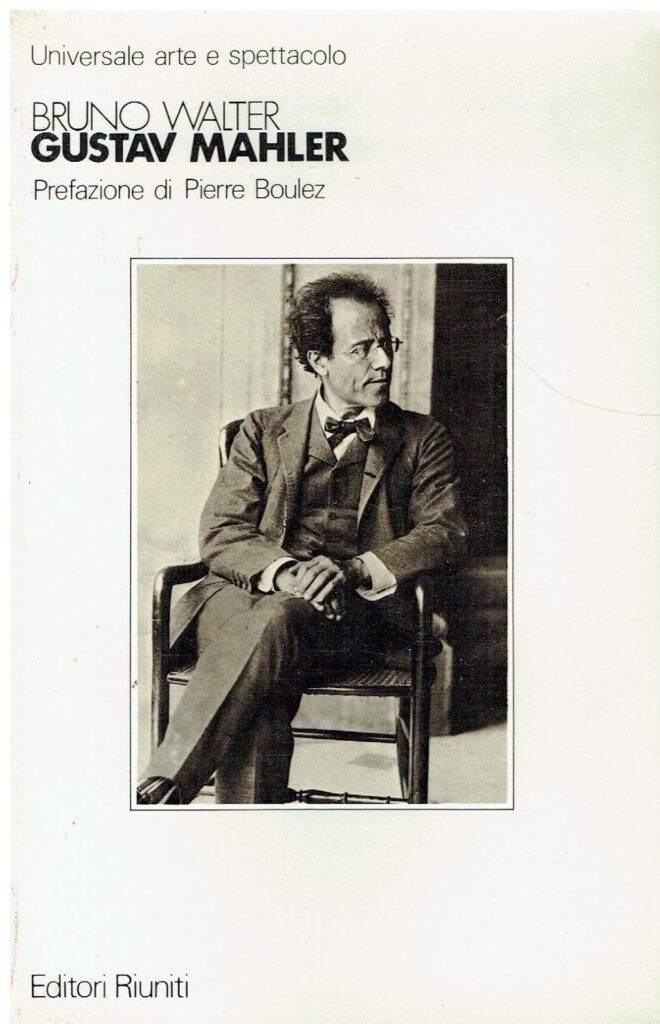
1. The Book as a Historical Document
Gustav Mahler by Bruno Walter is not a biography in the modern scholarly sense, but a primary historical testimony. It belongs to a rare category: books written by a direct artistic heir about the master whose work he helped bring into being.
Walter was not merely a colleague of Gustav Mahler; he was:
- Mahler’s assistant at the Vienna Court Opera,
- a trusted rehearsal partner,
- a conductor to whom Mahler entrusted premieres and revivals,
- and, after Mahler’s death, one of the main guardians of his symphonic legacy.
As such, the book captures Mahler from the inside: not Mahler the monument, but Mahler the working musician, the obsessive perfectionist, the morally uncompromising artist, and the deeply vulnerable human being.
2. Nature and Limits of Walter’s Testimony
Walter writes with devotion, gratitude, and moral loyalty. This gives the book enormous value—but also clear limits.
Strengths
- First-hand descriptions of rehearsal practices, phrasing, tempo flexibility, and orchestral balance.
- Direct insight into Mahler’s ethical conception of music, especially his belief that interpretation was a moral responsibility, not a matter of taste.
- A vivid portrayal of Mahler’s inner solitude, nervous tension, and metaphysical seriousness.
Limitations
- Walter avoids polemic and largely suppresses conflict (Vienna politics, antisemitism, institutional hostility).
- Mahler is presented as a spiritual and ethical authority, sometimes idealized.
- There is little critical distance; the book is testimonial, not analytical.
This is precisely where Pierre Boulez’s preface becomes crucial.
3. The Preface by Pierre Boulez: Why It Matters
The preface by Pierre Boulez does not merely introduce the book; it reframes it for the modern reader.
Boulez, coming from a radically different aesthetic world—post-war modernism, structural rigor, analytical clarity—was acutely aware that Mahler had long been misunderstood, sentimentalized, or mythologized. His preface serves three essential functions:
4. Boulez’s First Key Point: Historical Distance
Boulez emphasizes that Walter’s book must be read as a document of proximity, not as a final truth.
He makes clear that:
- Walter writes from within Mahler’s orbit, emotionally and ethically.
- This closeness is its strength, but also its bias.
- The reader must understand the book as a historical voice, not a neutral account.
Boulez thus protects the text from two dangers:
- blind veneration,
- and anachronistic dismissal.
5. Boulez’s Second Key Point: Against Sentimental Mahler
One of Boulez’s most important interventions is his rejection of a purely emotional or mystical Mahler.
Boulez insists that:
- Mahler’s music is not an outpouring of uncontrolled subjectivity,
- but a highly constructed, architecturally rigorous language,
- whose emotional power arises from structural necessity, not indulgence.
In this sense, Boulez implicitly corrects Walter’s tone.
Where Walter emphasizes spiritual depth and moral seriousness, Boulez reminds us that Mahler was also:
- an extreme rational organizer of musical time,
- a master of form, orchestration, and long-range tension.
6. Boulez’s Third Key Point: Mahler as a Modern Composer
Boulez situates Mahler not as the end of Romanticism, but as a precursor of modern musical thought.
He underlines:
- Mahler’s fragmentation of form,
- his use of irony and distance,
- his treatment of orchestral color as a structural element,
- and his constant questioning of inherited symphonic conventions.
This is a decisive reframing:
Mahler is no longer a late Romantic victim of excess, but a central figure in the crisis of tonality and form that defines the 20th century.
7. The Tension Between Walter and Boulez (and Why It Is Productive)
What makes editions with Boulez’s preface so valuable is the productive tension between the two voices:
- Walter → ethical witness, emotional proximity, lived experience
- Boulez → analytical distance, modernist clarity, historical re-situating
They do not contradict each other; they complete each other.
Walter tells us who Mahler was to live with.
Boulez tells us why Mahler still matters structurally and historically.
8. Why This Combination Is Ideal for Today’s Reader
For a contemporary reader—especially one deeply engaged with Mahler’s music—this edition offers a double lens:
- a human, moral, and experiential portrait (Walter),
- framed by a lucid, unsentimental modern perspective (Boulez).
This makes the book not nostalgic, but intellectually alive.
9. Final Evaluation
Gustav Mahler by Bruno Walter, with a preface by Pierre Boulez, should be read as:
- a primary source, not a critical biography,
- a testimony, not a verdict,
- a bridge between generations of Mahler understanding.
Walter preserves the ethical and human core of Mahler.
Boulez restores his formal radicalism and modern relevance.
Together, they offer one of the most balanced and illuminating entry points into Mahler’s world.