Vivaldi – Genuis of the Baroque by Marc Pincherle (Biography)
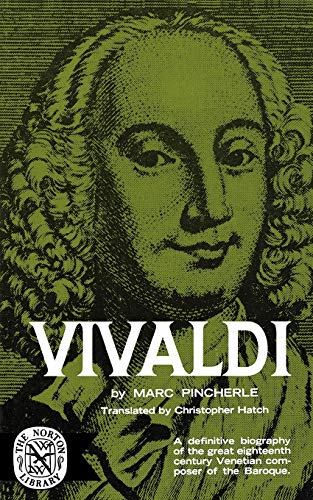
Marc Pincherle – Vivaldi: Genius of the Baroque
The Book
Vivaldi: Genius of the Baroque, written by Marc Pincherle, is one of the foundational modern biographies of Antonio Vivaldi. First published in French in the mid-20th century and later translated into English, the book represents the earliest serious attempt to reconstruct Vivaldi’s life and artistic stature using archival research, at a time when the composer was still largely absent from mainstream musical consciousness.
Before Pincherle, Vivaldi was known almost exclusively through a handful of concertos (The Four Seasons above all), while the vast majority of his sacred, operatic, and instrumental output remained unknown or unpublished.
Historical Context
Pincherle’s biography must be understood against the backdrop of the Vivaldi revival that began in the 1920s and 1930s, following the rediscovery of Vivaldi manuscripts in Turin. When Pincherle wrote this book, Vivaldi was still considered a secondary figure, often reduced to a prolific but repetitive craftsman.
The book’s historical importance lies in its rehabilitative mission: to demonstrate that Vivaldi was not merely a provider of pleasant concertos, but a composer of inventive form, dramatic imagination, and emotional intensity, whose influence shaped the language of the late Baroque.
Structure and Method
The biography follows a broadly chronological structure, tracing:
- Vivaldi’s early life in Venice, including his ordination and physical condition
- His long association with the Ospedale della Pietà
- His career as a violin virtuoso and teacher
- His activities as an opera composer and impresario
- His final years, decline, and death in Vienna
Pincherle combines documentary evidence with stylistic observation, offering clear descriptions of musical form, rhythm, and instrumental writing, without heavy technical analysis. The tone is scholarly but accessible, aimed at restoring historical dignity rather than advancing theoretical debate.
Major Contributions
The book’s enduring value rests on several key achievements:
- The first coherent narrative of Vivaldi’s life, based on archival sources rather than anecdote
- A forceful argument for Vivaldi’s originality, especially in concerto form and orchestral color
- Serious attention to Vivaldi’s sacred music and operas, long neglected in earlier accounts
- A portrayal of Vivaldi as a complex, driven, and sometimes precarious figure, shaped by the economics of Venetian musical life
Pincherle emphasizes Vivaldi’s dramatic instincts, presenting him as a composer whose instrumental music often behaves like opera without words.
Critical Reception and Later Criticism
At the time of publication, the book was widely praised and quickly became the standard reference on Vivaldi in several languages. It played a decisive role in encouraging further research, editions, and performances.
Later scholarship, however, has identified limitations:
- Some biographical assumptions are now known to be speculative or incomplete, due to limited sources available at the time
- The musical analysis, while insightful, lacks the systematic rigor of later studies by Talbot or Strohm
- Pincherle occasionally adopts a romanticized tone, characteristic of early 20th-century musicology
Nevertheless, these issues reflect the book’s pioneering status rather than scholarly weakness.
Importance and Legacy
Today, Vivaldi: Genius of the Baroque is regarded as a landmark work—not because it is definitive, but because it made modern Vivaldi studies possible. Nearly all subsequent research stands, in one way or another, on foundations Pincherle helped establish.
The book remains valuable for readers interested in:
- The rediscovery of Baroque composers
- Early 20th-century musicological methods
- A readable, historically grounded introduction to Vivaldi’s life and music
It is best read today alongside later biographies, but it retains its authority as the work that first restored Vivaldi’s reputation as a major composer of the Baroque.