Vaughan Williams on Music, Edited by David Manning
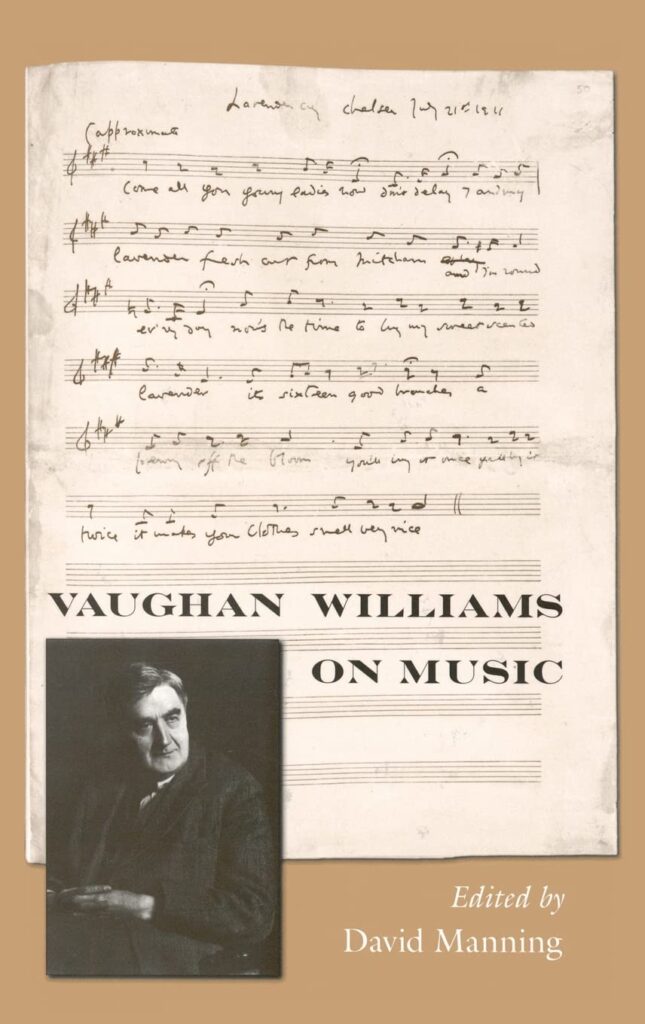
History of the book: origin, conception, and intellectual purpose
Vaughan Williams on Music was not conceived by Ralph Vaughan Williams as a single, unified book. Instead, it is the result of a deliberate late-20th / early-21st-century editorial project aimed at recovering, organizing, and recontextualizing the composer’s extensive writings on music, many of which had long existed only in scattered, inaccessible, or out-of-print sources.
Origins: a dispersed legacy
Throughout his life, Vaughan Williams wrote prolifically about music. His output included:
- newspaper and journal articles
- public lectures and radio talks
- prefaces and program notes
- essays on folk song, church music, nationalism, and musical education
These texts were written in response to immediate cultural debates, not with the intention of forming a systematic treatise. As a result, Vaughan Williams’s musical thought survived in fragments, often quoted selectively and sometimes simplistically.
By the late 20th century, scholars increasingly recognized that this fragmentation had distorted the composer’s intellectual profile, reducing him to slogans (“English pastoral,” “folk nationalist”) that failed to reflect the depth and nuance of his thinking.
The editorial impulse
The idea behind Vaughan Williams on Music was to restore Vaughan Williams’s own voice, allowing him to speak directly—across decades—about music’s meaning, function, and moral responsibility.
David Manning’s role as editor was therefore not merely archival, but curatorial and interpretive:
- to select representative texts spanning Vaughan Williams’s entire career
- to establish reliable versions of those texts
- to arrange them thematically rather than chronologically
- and to contextualize them with minimal but precise editorial guidance
The guiding principle was clarity without distortion: Vaughan Williams explains Vaughan Williams.
From occasional writing to coherent thought
One of the book’s key achievements lies in demonstrating that Vaughan Williams’s writings, though occasional in origin, reveal a remarkably consistent intellectual position when viewed as a whole.
Across essays written decades apart, recurring themes emerge:
- skepticism toward aesthetic dogma
- resistance to musical elitism
- belief in tradition as a living process
- the ethical and social responsibility of composers
- distrust of purely technical or academic conceptions of music
The book’s structure makes visible what had previously been obscured: that Vaughan Williams was not a casual commentator, but a coherent musical thinker with a strong moral framework.
Editorial philosophy
Manning avoided rewriting, modernizing language, or imposing retrospective interpretation. The editorial approach favors:
- original wording
- historical accuracy
- minimal annotation
- respect for Vaughan Williams’s rhetorical style
This restraint ensures that the book functions as a primary-source document, not as a secondary commentary disguised as the composer’s voice.
Publication context
When the book appeared in 2008, it responded to a renewed scholarly interest in:
- composer-authored writings
- cultural history of music
- the relationship between music, society, and ethics
Within this context, Vaughan Williams on Music positioned Vaughan Williams alongside figures such as Debussy, Schoenberg, Stravinsky, and Hindemith, whose writings were already recognized as central to understanding their artistic identities.
Significance
The publication of this volume marked a turning point in Vaughan Williams studies. It helped shift critical perception:
- away from stylistic caricature
- toward intellectual seriousness
- and toward Vaughan Williams as a composer-thinker, not merely a national stylist
The book’s lasting value lies in its refusal to explain Vaughan Williams for the reader. Instead, it allows him to argue, provoke, doubt, and reflect in his own words.
In summary
Vaughan Williams on Music exists because Vaughan Williams’s ideas mattered too much to remain dispersed. The book is the result of a conscious effort to reassemble a fragmented intellectual legacy into a readable, authoritative whole, offering direct access to one of the most thoughtful musical minds of the 20th century.