The Secret Life of Glenn Gould – Michael Clarkson
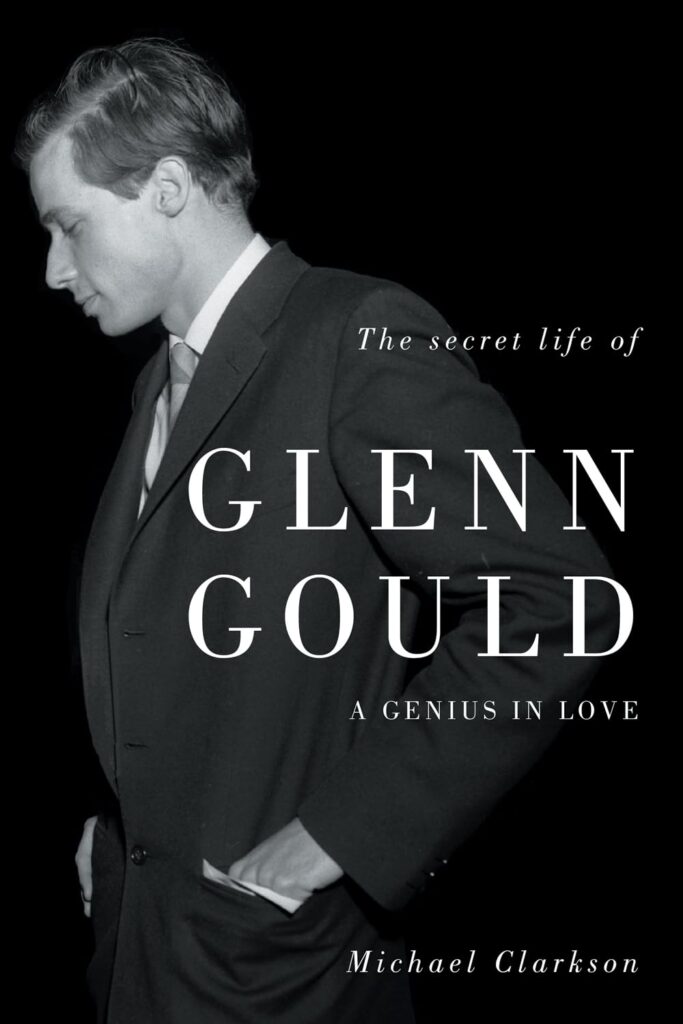
The Secret Life of Glenn Gould occupies a very specific and revealing place within the vast Gould literature. Rather than offering a formal, musicological biography, Michael Clarkson—a Canadian journalist and cultural commentator—constructs a psychological, behavioral, and social portrait, focusing on the man behind the public myth. The book is less concerned with analytical discussion of interpretations than with how Gould lived, thought, feared, controlled, and staged himself.
Conception and Intent
Clarkson’s premise is clear: Glenn Gould was not merely eccentric, but strategically private and deliberately theatrical, a man who curated his own legend while fiercely protecting his inner life. The “secret life” of the title does not imply scandal, but rather layers of concealment—habits, routines, anxieties, and contradictions that Gould carefully shielded from public view.
The book emerged at a moment when Gould was already becoming a cultural icon in Canada, yet many of his personal behaviors were still surrounded by rumor. Clarkson’s goal was to demystify without sensationalizing, using interviews, recollections, and contemporary reportage.
Gould’s Private World
One of the book’s central achievements is its detailed account of Gould’s daily routines and idiosyncratic habits. Clarkson documents Gould’s obsession with control: temperature regulation, clothing, seating height, recording conditions, and physical isolation. These were not random quirks, but part of a defensive system designed to minimize unpredictability.
Gould’s avoidance of physical contact, his fear of illness, and his reliance on telephones rather than face-to-face meetings are treated as elements of a coherent psychological strategy rather than pathology alone.
The Performer Who Rejected the Stage
Clarkson devotes significant attention to Gould’s famous withdrawal from the concert stage in 1964. Rather than framing it as arrogance or withdrawal from pressure, the book presents it as a philosophical and psychological necessity. Live performance represented exposure, risk, and loss of control—conditions Gould found intolerable.
The recording studio, by contrast, allowed Gould to construct an idealized version of himself, assembling performances through takes, edits, and reflection. Clarkson shows how this choice shaped not only Gould’s career but the future of recorded music.
Media, Persona, and Self-Mythologizing
A recurring theme is Gould’s manipulation of media. Clarkson portrays Gould as deeply media-savvy, fully aware of how interviews, radio documentaries, and photographs could be used to shape public perception. Gould’s radio work for the CBC—often playful, ironic, and layered with voices—becomes evidence of his fascination with identity as performance.
The book suggests that Gould was both subject and author of his own myth.
Relationships and Emotional Distance
Clarkson is careful when addressing Gould’s relationships. The book avoids speculation and instead emphasizes distance, guarded intimacy, and emotional compartmentalization. Gould valued connection but feared vulnerability. Friendships were often conducted by telephone, at odd hours, and under strict boundaries.
This emotional distance is presented not as coldness, but as self-preservation.
Health, Anxiety, and Control
Without indulging in medical diagnosis, the book explores Gould’s lifelong anxiety, hypochondria, and reliance on medication. Clarkson avoids moral judgment, framing these elements as part of a fragile equilibrium that enabled Gould’s extraordinary focus and productivity.
Tone and Style
Clarkson writes in a clear, journalistic style, accessible and narrative-driven. The book does not aspire to academic depth, but its strength lies in observation and synthesis. It is particularly valuable for readers seeking to understand how Gould functioned as a human being, rather than how he analyzed Bach.
Assessment and Place in Gould Literature
The Secret Life of Glenn Gould complements more scholarly works by figures such as Kevin Bazzana by offering a human-scale portrait. It is best read not as a definitive biography, but as a psychological case study of artistic isolation, control, and self-invention.
The book reinforces a central truth about Gould:
his genius cannot be separated from the mechanisms he built to survive it.
Publication data
- First publication: 1989
- Publisher: Macmillan of Canada
- Format: Hardcover (original), later paperback editions
- Context: Published seven years after Gould’s death (1982), at a time when personal recollections were still fresh and the Gould myth was actively forming.