The Life of Johannes Brahms (Vol 1&2) by Florence May
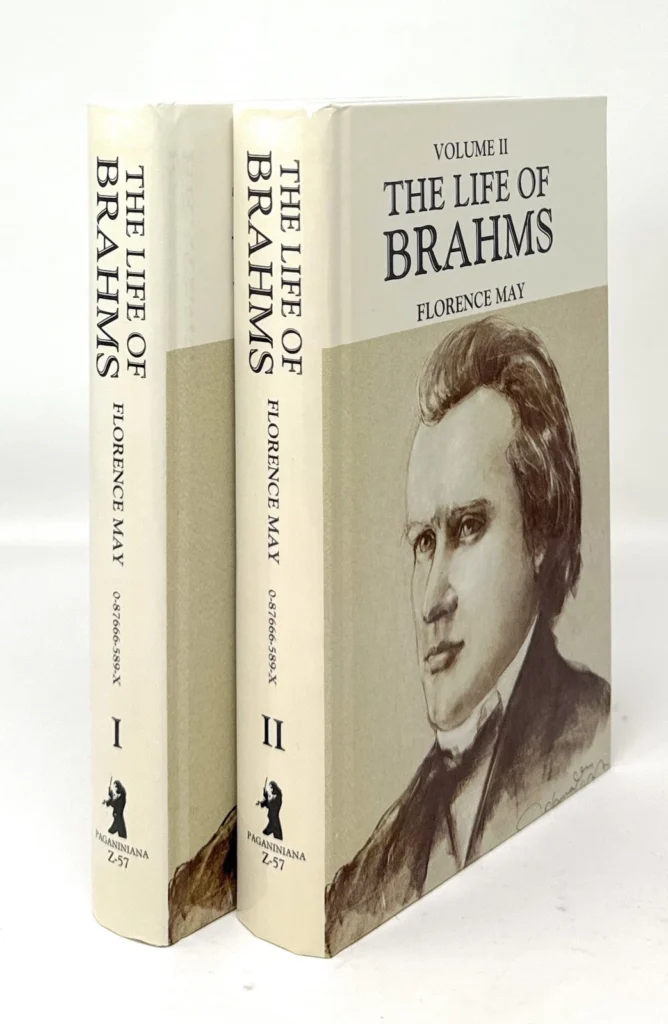
The Life of Johannes Brahms
by Florence May
1. Nature, Intention, and Historical Position of the Book
The Life of Johannes Brahms by Florence May occupies a very particular and important place in Brahms biography. Unlike later scholarly studies, this book is not primarily archival or documentary in method. Instead, it is a first-generation biographical testimony, written by someone who knew Brahms personally, moved within his social and artistic circle, and observed his habits, speech, and character over many years.
Florence May was not a professional historian but a cultivated pianist, writer, and close acquaintance of Brahms. Her aim was not to produce a critical edition of facts, but to preserve the living memory of Brahms as a human being, before that memory faded or became distorted by legend. As such, her biography complements—rather than replaces—later scholarly works.
Its value lies in proximity, atmosphere, and character observation, not in exhaustive documentation.
2. Florence May’s Personal Relationship with Brahms
One of the defining strengths of the book is the author’s direct personal contact with Brahms, especially during his later years in Vienna. Florence May writes as an observer who heard Brahms speak, joke, argue, and reflect, and who was received in his domestic and social environment.
She is careful not to present herself as a confidante of the deepest inner life, but rather as a trusted member of the outer circle, close enough to observe habitual behavior and attitudes. This gives her account a tone of measured intimacy—warm, respectful, but not sentimental.
Her Brahms is not monumental or abstract; he is present, concrete, and socially recognizable.
3. Early Life: Hamburg without Romanticization
In her treatment of Brahms’s early years in Hamburg, Florence May avoids melodrama. She does not sensationalize poverty, nor does she exaggerate hardship. Instead, she presents a working-class musical household, disciplined, practical, and oriented toward professional survival.
Brahms’s father appears as industrious, musically competent, and supportive, while the young Brahms is shown as serious, reserved, and inwardly intense from an early age. Florence May emphasizes the moral seriousness and self-discipline that marked Brahms long before fame.
She does not mythologize the tavern-playing episodes of his youth, treating them as pragmatic professional engagements, not formative moral trauma.
4. Brahms’s Character: Reserve, Integrity, and Inner Fire
The psychological portrait is the book’s most enduring contribution. Florence May depicts Brahms as fundamentally reserved, even shy, but never cold. His irony, abruptness, and occasional brusqueness are interpreted not as misanthropy, but as defensive armor protecting a deeply sensitive nature.
She repeatedly stresses Brahms’s moral integrity, especially his intolerance for artistic compromise or empty display. Brahms appears as someone who measured himself relentlessly, held others to high standards, and distrusted facile success.
At the same time, she records his warmth, loyalty, humor, and generosity—particularly toward younger musicians—when trust had been established.
5. Brahms and the Question of Romanticism
Florence May offers a particularly nuanced view of Brahms’s relationship to Romanticism. She rejects the simplistic opposition between Brahms and the so-called “New German School.” In her account, Brahms is neither reactionary nor doctrinaire.
Instead, she presents him as emotionally Romantic but structurally classical: a composer who believed that feeling gains strength through discipline, not through rhetorical excess. This perspective is not analytical in a modern sense, but it reflects Brahms’s own remarks and attitudes as she heard them.
Her Brahms admires depth, continuity, and inwardness, and distrusts music that seeks effect without substance.
6. Brahms in Social Life: Vienna, Friendship, and Conversation
The Viennese chapters are especially vivid. Florence May recreates Brahms’s daily routines, cafés, walks, and musical evenings, giving the reader a sense of the rhythm of his life rather than a chronology of events.
Brahms appears as a keen conversationalist, capable of sharp wit, aphoristic judgments, and sudden tenderness. His friendships are shown as selective but enduring. Once loyalty was established, he remained constant.
Importantly, Florence May avoids intrusive speculation about Brahms’s private emotional life. She treats sensitive topics with discretion, reflecting both Victorian restraint and Brahms’s own insistence on privacy.
7. Artistic Conscience and Self-Criticism
A recurring theme is Brahms’s extraordinary self-criticism. Florence May emphasizes how much music he destroyed, revised, or withheld from publication. This was not insecurity, but ethical rigor—a belief that music released to the world must justify its existence.
She portrays Brahms as deeply conscious of historical responsibility, especially in relation to Beethoven’s legacy, though she avoids turning this into a dramatic burden narrative. Instead, it appears as quiet, persistent pressure, internalized rather than dramatized.
8. Limits of the Biography
From a modern scholarly perspective, the book has clear limitations. Dates, documents, and compositional processes are not treated exhaustively. Florence May rarely engages in critical musical analysis, and her narrative occasionally relies on memory rather than verification.
Yet these limitations are also part of its strength. The book does not compete with academic biographies; it records a living presence, a tone of voice, a moral stance.
9. Lasting Importance of Florence May’s Biography
The Life of Johannes Brahms remains indispensable because it captures Brahms before canonization. It preserves the image of a man still remembered as a person, not yet frozen into monument.
Later scholars correct facts and expand context, but they repeatedly return to Florence May for character, atmosphere, and human truth. Her Brahms is neither saint nor titan, but a working artist of immense seriousness, living quietly under the weight of his own standards.