Rudolf Serkin, A Life – Stephen Lehmann, Marion Faber
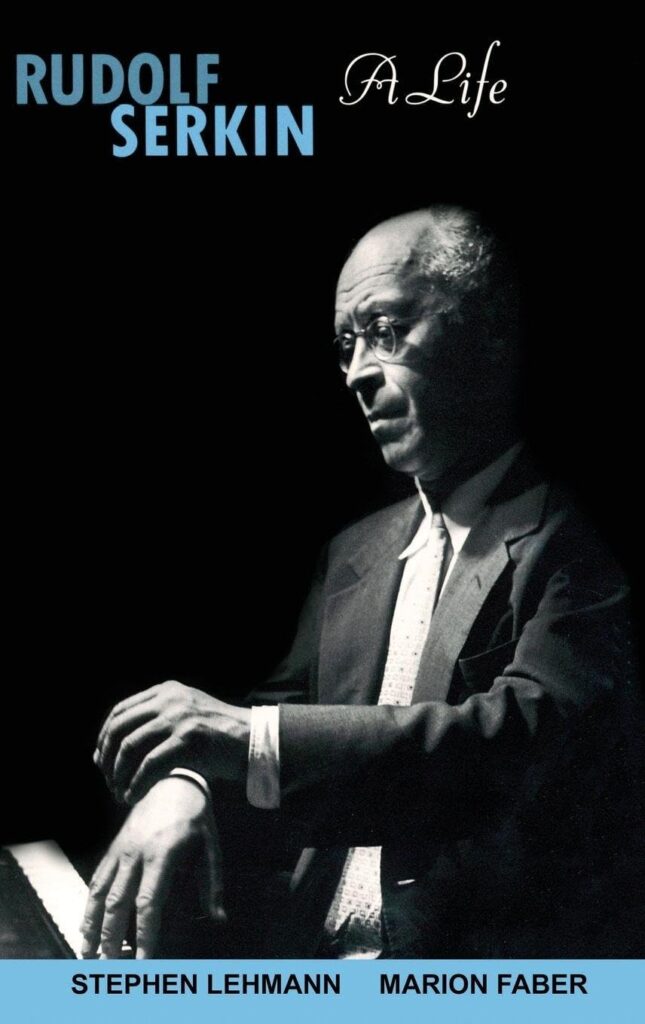
Publication data
Rudolf Serkin, A Life
Stephen Lehmann & Marion Faber
- First publication: 2012
- Publisher: Yale University Press (New Haven & London)
- Format at release: Hardcover
- Subsequent editions: Paperback editions followed shortly after the initial release (from 2013 onward), without substantive revision to the text.
These dates place the biography firmly in the post-archival phase of Serkin studies, benefiting from access to Marlboro materials, family correspondence, and long-term oral testimony gathered decades after his death (1991), which is one reason the book is regarded as definitive rather than commemorative.
This substantial biography stands as the most authoritative and intimate account of Rudolf Serkin’s life and artistic conscience. Written by two scholars deeply embedded in Serkin’s world—Stephen Lehmann, long associated with the Marlboro Music Festival, and Marion Faber, a meticulous historian and editor—the book combines first-hand testimony, archival depth, and musical understanding in a way few pianist biographies manage.
Origins and Formation
Born in 1903 in Eger (then Austria-Hungary), Serkin emerged as a prodigy within the Central European Austro-German tradition. The book traces his early studies with Richard Robert in Vienna and his rapid ascent not as a flashy virtuoso but as a musician defined by structural clarity, moral seriousness, and intellectual rigor. From the outset, Serkin’s pianism is framed not as a “career” but as a vocation—music as ethical responsibility.
Exile, Loss, and Artistic Integrity
A central narrative axis is exile. As a Jewish artist forced to flee Nazism, Serkin’s emigration to the United States in the late 1930s marked both rupture and rebirth. Lehmann and Faber handle this period with restraint and gravity, showing how displacement intensified Serkin’s inner discipline. His refusal to compromise repertoire, his suspicion of glamour, and his almost ascetic concert demeanor are read as moral responses to historical trauma, not mere temperament.
The Pianist as Thinker
One of the book’s greatest strengths is its treatment of Serkin’s repertoire—especially Beethoven, Schubert, Brahms, and Mozart—not through technical analysis alone but through interpretive philosophy. Serkin’s famously uncompromising performances, sometimes rough-edged yet spiritually charged, are contextualized as deliberate acts: fidelity to the score, resistance to narcissism, and a belief that music must remain larger than the performer.
Marlboro and the Ethics of Music-Making
The Marlboro Music Festival occupies a major and deeply affectionate portion of the book. For Serkin, Marlboro was not an institution but a community of shared listening and humility, where young musicians learned through dialogue rather than instruction. Lehmann’s proximity allows for especially vivid chapters here, portraying Serkin as mentor, catalyst, and guardian of musical values rather than a conventional teacher.
Private Life and Inner Contradictions
Without sensationalism, the authors explore Serkin’s personal life—his marriage into the Busch musical family, his emotional reserve, his self-doubt, and his relentless self-criticism. The portrait that emerges is deeply human: a man revered by colleagues yet perpetually dissatisfied with his own playing, haunted by the idea that music could never be fully realized.
Assessment and Legacy
Rather than mythologizing, Rudolf Serkin, A Life insists on complexity. Serkin is neither saint nor relic of a vanished age, but a musician whose life poses enduring questions:
What does it mean to serve music rather than oneself?
Can artistic integrity survive fame, exile, and modernity?
The book ultimately presents Serkin as a moral figure in 20th-century musical life, whose influence lies not only in recordings and concerts but in an example of artistic conscience that continues to challenge performers today.