Richard Wagner and His World – Thomas S. Grey
History, conception, and intellectual scope of the book
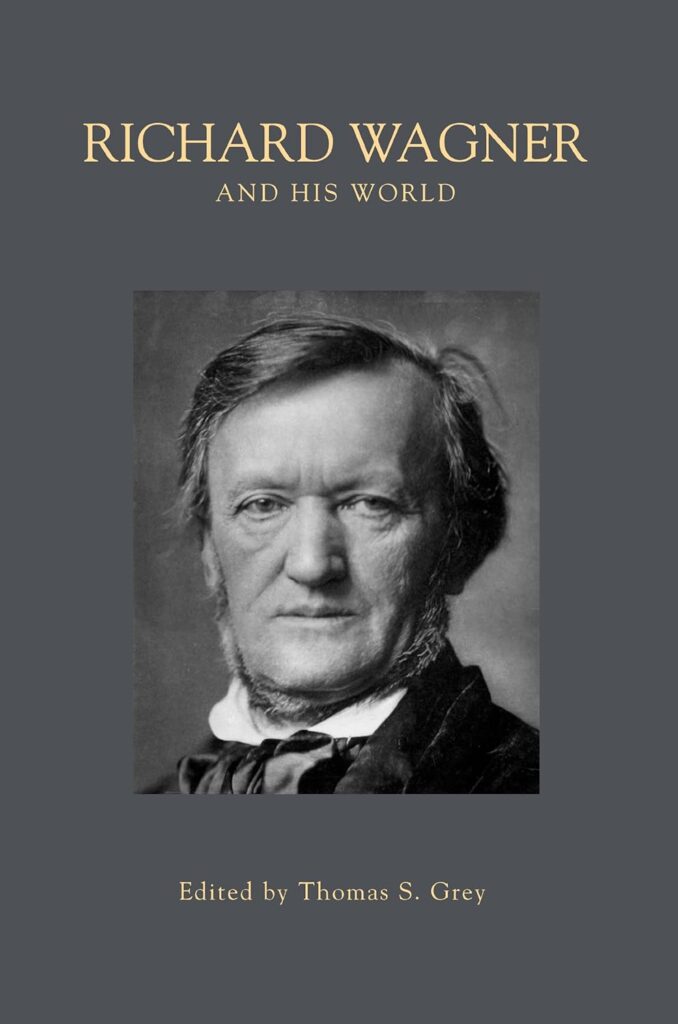
Richard Wagner and His World belongs to the distinguished “Composer and His World” series published by Princeton University Press, a collection designed to reassess major composers through multi-disciplinary, context-rich scholarship. The volume edited by Thomas S. Grey was conceived not as a traditional biography, but as a panoramic intellectual map of Wagner’s life, works, reception, and cultural afterlife.
Its guiding premise is simple but ambitious: Wagner cannot be understood through music alone. His operas, writings, politics, aesthetics, and posthumous influence form an inseparable whole, extending far beyond the 19th century into philosophy, nationalism, modernism, and ideology.
Editorial conception
Thomas S. Grey, one of the leading Wagner scholars of his generation, shaped the volume as a dialogue between disciplines rather than a single narrative voice. Instead of synthesizing Wagner into a unified interpretation, the book deliberately presents multiple perspectives, often in tension with one another.
The aim was not to resolve Wagner’s contradictions, but to expose them clearly:
- revolutionary and reactionary
- visionary dramatist and polemical writer
- musical innovator and ideological provocateur
Grey’s editorial strategy embraces this complexity as essential rather than problematic.
Structure and content
The book combines several types of material:
- newly commissioned scholarly essays
- historical documents and contemporary reactions
- reflections on Wagner’s reception and legacy
The essays address:
- Wagner’s aesthetic theories and prose writings
- the political context of his revolutionary years
- his relationship with philosophy (especially Schopenhauer)
- antisemitism and its long historical consequences
- Bayreuth as both artistic project and cultural symbol
- Wagner’s influence on later composers, thinkers, and regimes
This structure allows the reader to move between Wagner’s own century and ours, constantly confronting how meanings have shifted over time.
Wagner and ideology
One of the book’s central achievements is its unflinching treatment of Wagner’s antisemitism. Rather than isolating it as an unfortunate side issue or collapsing Wagner entirely into it, the volume places these writings within:
- 19th-century German intellectual history
- Wagner’s personal resentments and ambitions
- the later political instrumentalization of his ideas
This historically grounded approach avoids both apology and reductionism, making the volume especially valuable for modern readers.
Reception and afterlife
A substantial portion of the book is devoted to Wagner’s posthumous “world”—how his music and ideas were received, transformed, distorted, and appropriated. Bayreuth emerges as a living laboratory of Wagnerian meaning, shaped by:
- changing performance traditions
- political regimes
- aesthetic movements from symbolism to modernism
Wagner is shown not as a closed historical figure, but as a continuing cultural force, constantly reinterpreted.
Scholarly tone and significance
The tone of the book is analytical, sober, and intellectually demanding. It assumes a reader willing to engage with complexity rather than myth. Unlike biographies that seek narrative coherence, this volume offers contextual density.
Its importance lies in:
- resisting simplification
- integrating musicology with cultural history
- presenting Wagner as a problem to be thought through, not resolved
Publication data
- First publication: 2009
- Publisher: Princeton University Press (Princeton & Oxford)
- Series: The Composer and His World
- Initial format: Hardcover
- Later editions: Paperback edition issued in subsequent years, with no major textual changes
Assessment
Richard Wagner and His World stands as one of the most intellectually responsible Wagner books of the last decades. It neither venerates nor condemns simplistically. Instead, it insists that understanding Wagner requires historical awareness, ethical clarity, and analytical patience.
It is especially recommended for readers who already know Wagner’s music and seek to understand why Wagner continues to unsettle, provoke, and dominate cultural debate well into the 21st century.