Portrait of Mendelssohn by Clive Brown
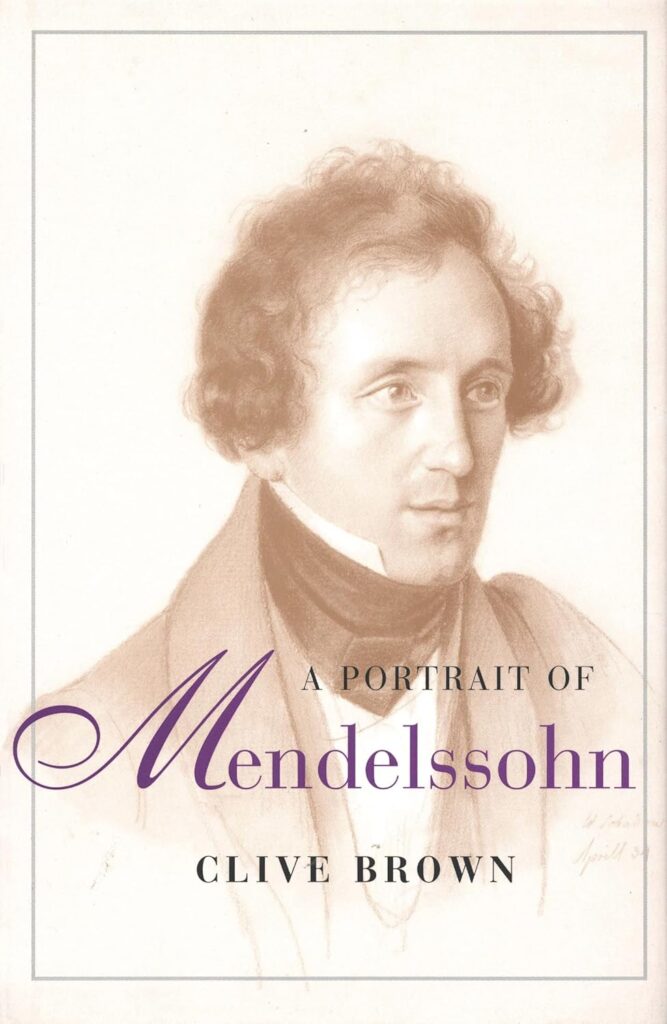
Portrait of Mendelssohn
Clive Brown
- First publication: 2003
- Publisher: Yale University Press (New Haven & London)
- Initial format: Hardcover
- Subsequent editions: Paperback edition issued shortly after the first release (from 2004–2005 onward), with no substantial revision of the text.
The book belongs to Yale University Press’s tradition of analytical, historically grounded composer portraits, positioning it between biography, aesthetic study, and performance-practice scholarship rather than as a purely narrative life.
Portrait of Mendelssohn is one of the most balanced, intellectually rigorous, and stylistically sober studies of Felix Mendelssohn ever written. Rather than offering a conventional cradle-to-grave biography, Clive Brown constructs a multi-faceted psychological and cultural portrait, placing Mendelssohn at the intersection of personality, aesthetics, performance practice, and 19th-century intellectual life.
Conception and Aim of the Book
Brown’s stated aim is not to rehabilitate Mendelssohn polemically, nor to dismantle him critically, but to restore proportion. Mendelssohn had long suffered from caricature: either idealized as a flawless classical gentleman or dismissed as a conservative lightweight. This book rejects both extremes, presenting Mendelssohn as complex, historically situated, and artistically self-aware.
Rather than narrating events mechanically, Brown asks how Mendelssohn thought, how he worked, and why his artistic choices mattered in their time.
Mendelssohn’s Personality and Inner World
One of the book’s strongest sections concerns Mendelssohn’s character. Brown draws extensively on letters, diaries, and contemporary testimony to show a man of intense discipline, emotional control, and acute self-criticism. Mendelssohn’s famous elegance and clarity are not signs of superficiality but of conscious restraint.
Brown emphasizes that Mendelssohn was not naïve about the world. He was acutely aware of politics, religion, and social tension, yet chose artistic moderation as an ethical stance, not as an escape.
The Composer Between Classicism and Romanticism
Brown dismantles the simplistic label of Mendelssohn as “anti-Romantic.” Instead, he shows a composer who redefined Romanticism through classical balance. Mendelssohn’s admiration for Bach, Mozart, and Beethoven coexisted with a Romantic sensibility grounded in nature, travel, and introspection.
The book argues persuasively that Mendelssohn’s formal clarity was a modern response to excess, not a retreat into the past.
Performance Practice and Musical Thought
A distinctive feature of Portrait of Mendelssohn is Brown’s deep engagement with performance practice. Mendelssohn is treated not only as a composer but as a performer, conductor, editor, and interpreter.
Brown examines:
- Mendelssohn’s tempi and articulation
- His approach to phrasing and dynamics
- His editorial decisions in Bach and Handel
These discussions illuminate Mendelssohn’s belief that faithfulness to the score and expressive freedom were not opposites, but mutually reinforcing.
The Bach Revival Reconsidered
Rather than presenting the 1829 St Matthew Passion revival as a single heroic gesture, Brown places it within a broader intellectual framework. Mendelssohn emerges as a mediator of tradition, shaping how earlier music could speak to a modern audience without distortion.
This nuanced treatment avoids mythologizing while underscoring Mendelssohn’s decisive historical role.
Religion, Identity, and Cultural Position
Brown handles Mendelssohn’s Jewish background and Protestant upbringing with exceptional care. He neither reduces Mendelssohn’s career to questions of identity nor ignores the cultural pressures he faced.
Instead, Mendelssohn appears as a figure navigating belonging and distance, assimilation and individuality—issues that deeply influenced how his music was later received and misrepresented.
Critical Reception and Historical Misreading
A major contribution of the book is its analysis of Mendelssohn’s posthumous reception, including the distortions introduced by Wagnerian aesthetics and later ideological agendas.
Brown shows how Mendelssohn’s reputation suffered not because of musical weakness, but because his values conflicted with later narratives of artistic heroism, struggle, and transgression.
Style and Scholarly Value
Brown’s prose is measured, lucid, and unsensational, mirroring the very qualities he attributes to Mendelssohn. The book avoids polemic and instead builds its case through cumulative insight.
It is especially valuable for:
- Readers interested in 19th-century musical thought
- Performers seeking historically informed perspective
- Scholars reassessing Mendelssohn beyond stereotypes
Assessment
Portrait of Mendelssohn stands as one of the most intellectually honest Mendelssohn studies available in English. It neither glorifies nor diminishes its subject, but restores him as a serious, reflective, and historically decisive musician, whose restraint was not a limitation but a conscious artistic ideal.