Life of Bach – Albert Schweitzer Vol 1
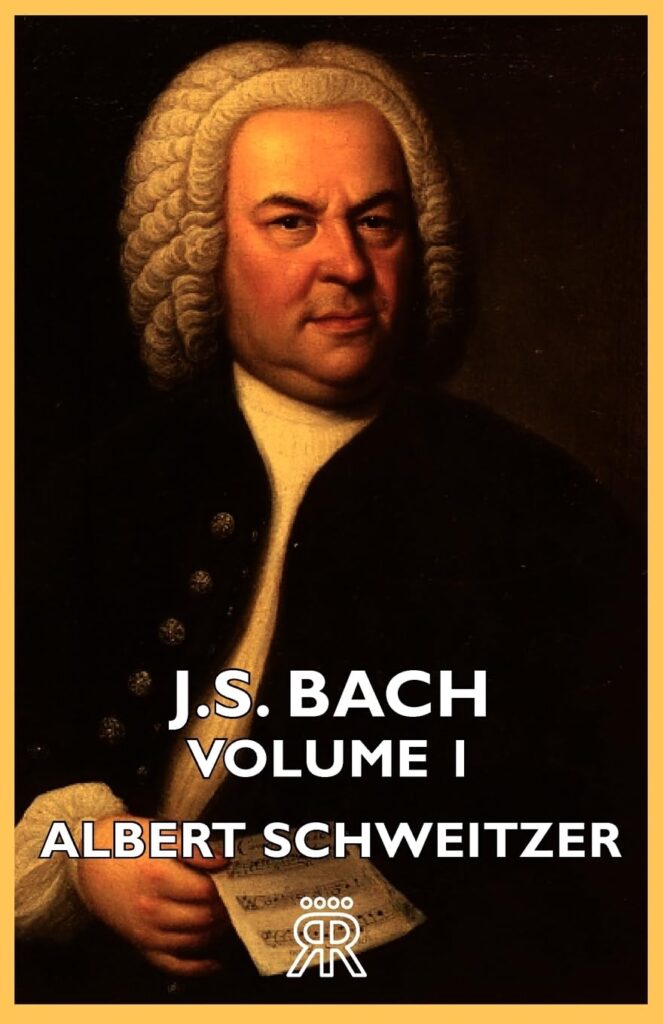
The Life of Bach — Volume I
Bibliographical details
- Author: Albert Schweitzer
- Original title: J. S. Bach
- First publication: 1905 (in German)
- Volume I (English editions): published as part of the two-volume English translation in the early 20th century
- Publisher (classical English editions): A. & C. Black (London)
- Structure: Volume I focuses primarily on Bach’s life and historical background, while Volume II is devoted mainly to musical analysis
This work is one of the foundational modern Bach biographies, and for decades it shaped how Bach was understood in the English-speaking world.
The Author: Albert Schweitzer
Full name: Albert Schweitzer
Born: 14 January 1875, Kaysersberg (Alsace)
Died: 4 September 1965, Lambaréné (Gabon)
Albert Schweitzer was a polymath of exceptional breadth: theologian, philosopher, physician, humanitarian, organist, and musicologist. He was awarded the Nobel Peace Prize (1952) for his humanitarian work in Africa.
In music, Schweitzer was:
- A leading Bach interpreter and scholar
- A specialist in organ music and performance practice
- A close associate of major early-music figures, including Charles-Marie Widor
His musical thought was deeply influenced by theology and ethics, which strongly colors his view of Bach.
Scope and character of Volume I
Volume I of The Life of Bach is primarily a biographical and historical study, not a technical analysis of individual works. Schweitzer reconstructs Bach’s life through:
- Family background and musical lineage
- Education and early professional years
- Bach’s posts in Arnstadt, Mühlhausen, Weimar, Köthen, and Leipzig
- The religious, cultural, and intellectual world of Lutheran Germany
The emphasis lies on Bach as a working musician embedded in a spiritual and social tradition, rather than as a Romantic genius isolated from context.
Schweitzer’s view of Bach
Schweitzer presents Bach as:
- A profoundly religious artist
- A composer whose music is inseparable from Lutheran theology
- An intellectual craftsman rather than a self-dramatising personality
Bach’s character is portrayed with restraint: Schweitzer avoids anecdotal excess and psychological speculation, preferring to interpret Bach’s inner life through his artistic and spiritual convictions.
Method and perspective
Schweitzer’s biography reflects early 20th-century scholarship, but it was revolutionary in its time for:
- Treating Bach’s music as symbolic and expressive, not merely formal
- Interpreting musical structures in relation to text, theology, and imagery
- Rejecting purely abstract or mechanical readings of Bach’s style
Although later scholarship has revised many details, Schweitzer’s conceptual framework remains influential.
Place within Bach literature
The Life of Bach (Volume I) stands as:
- One of the cornerstones of Bach reception history
- A bridge between 19th-century biography and modern musicology
- A work that shaped performance, interpretation, and listening habits for generations
It is less a neutral documentary biography than a visionary interpretation, in which Bach emerges as a spiritual and moral force in Western music.
In summary
Albert Schweitzer’s The Life of Bach, Volume I, is a classic, historically decisive biography. While not aligned with modern archival rigor, it remains essential for understanding how Bach’s life was first integrated into a coherent artistic and spiritual worldview. It is indispensable not only as a biography of Bach, but as a document of 20th-century musical thought itself.