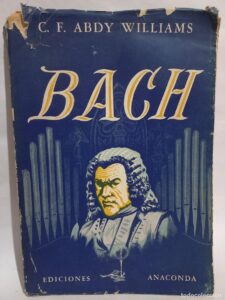
Bach
Researched Bibliographic Dossier
Verified edition data and a musicological research note prepared specifically for this work.
- Title
- Bach
- Author
- C. F. Abdy Williams
- Publisher
- Historical edition / bibliographic record
- Language
- English or original-language historical edition
- Type
- Biography / introductory study
SCOPE & CONTENT
This curated dossier identifies Bach by C. F. Abdy Williams as a distinct Library resource and makes it discoverable through normalized title and author forms. The work is valuable as a historical source, critical study or documentary witness and belongs to the core literature surrounding musical biography, correspondence and reception.
RESEARCH VALUE
For research use, the record should be read in its historical context. Older biographies and memoir-based studies can preserve unique testimony while also reflecting the assumptions and limitations of their period. The dossier emphasizes discoverability and bibliographic identification without presenting every historical claim as current scholarly consensus.
HISTORICAL VALUE
The work is retained as part of the documentary history of classical-music scholarship and reception.
SEARCH AND CATALOGUE ROLE
Title and author aliases are stored independently from the physical filename so Library can retrieve the record even when the uploaded document has an abbreviated or inconsistent technical name.
- Format
- File size
- 4.5 MB
- Subjects / people
- Books & Essays · Composers · Johann Sebastian Bach · Essays & Reception
- Catalogue completeness
- 4 / 10 core bibliographic fields
Extended Editorial Dossier
Existing Classical Archive editorial content associated with this document, integrated here as reference material. File controls and direct PDF/DOC links are excluded from this bibliographic copy.
Johann Sebastian Bach by C. F. Abdy Williams — An Early English Portrait
The book Bach by C. F. Abdy Williams belongs to the early English-language tradition of Bach biography, written at a time when Johann Sebastian Bach was only beginning to be fully understood outside German-speaking countries. First published at the turn of the 20th century, the book reflects both the limitations and the ambitions of Bach scholarship in the Victorian and Edwardian eras.
Abdy Williams was not a specialist Bach scholar in the modern sense, but a cultivated English musicologist, organist, and writer whose goal was to introduce Bach to an educated general readership. His biography is therefore as much an act of advocacy as of documentation.
Context and Purpose of the Book
When Abdy Williams wrote this book, Bach was still widely regarded in Britain primarily as:
- a supreme organ composer,
- a master of counterpoint,
- and a somewhat austere, academic figure.
Large portions of Bach’s vocal music were still rarely performed, many cantatas were unpublished or inaccessible, and the idea of Bach as a dramatic, emotional, and human composer had not yet fully entered mainstream consciousness.
Abdy Williams’ aim was to humanize Bach, presenting him not merely as a learned craftsman but as a living musician shaped by family life, professional pressures, religious conviction, and institutional conflict.
Structure and Content
The biography follows a largely chronological narrative, covering:
- Bach’s family background and musical ancestry
- His early years as an organist
- His professional appointments (Arnstadt, Mühlhausen, Weimar, Köthen, Leipzig)
- His role as cantor, teacher, and civic musician
- A general overview of his major works
Rather than detailed source criticism, the book emphasizes clarity, narrative flow, and stylistic explanation. Musical examples are used sparingly and explained verbally, making the book accessible to readers without advanced technical training.
Bach as Seen by Abdy Williams
Abdy Williams presents Bach as:
- Deeply conscientious, sometimes inflexible
- Intensely religious, but not mystical in an abstract sense
- A craftsman driven by duty rather than ambition
- A figure frequently misunderstood and undervalued by his contemporaries
There is a strong moral tone typical of English biographies of the period: Bach appears as a model of integrity, seriousness, and devotion to work. Conflict with authorities (especially in Leipzig) is acknowledged, but often softened or moralized rather than analyzed structurally.
Strengths of the Book
- One of the earliest coherent English introductions to Bach’s life
- Clear, readable prose aimed at non-specialists
- Useful synthesis of 19th-century German scholarship
- Emphasis on Bach’s professional reality, not just his genius
For modern readers, the book is especially valuable as a historical document: it shows how Bach was perceived before the explosion of modern Bach research and historically informed performance.
Limitations from a Modern Perspective
From today’s standpoint, the book naturally shows its age:
- Limited access to primary sources
- Dependence on earlier biographers (especially Spitta)
- Lack of detailed cantata-by-cantata or work-by-work analysis
- Minimal attention to performance practice
However, these limitations do not diminish its importance as a foundational English text.
Place in Bach Literature
Bach by C. F. Abdy Williams occupies an intermediate position between:
- the monumental German scholarship of the 19th century
- and the more analytical, contextual biographies of the late 20th century
It helped prepare English-speaking audiences for a deeper engagement with Bach, paving the way for later writers such as Albert Schweitzer, Charles Sanford Terry, and modern Bach scholars.
Conclusion
This book is not a definitive Bach biography by modern standards, but it remains a significant milestone in the English reception of Johann Sebastian Bach. It reflects a moment when Bach was transitioning from learned monument to living musical presence in the Anglophone world.