J. S. Bach: A Life in Music
Researched Bibliographic Dossier
Verified edition data and a musicological research note prepared specifically for this work.
- Title
- J. S. Bach: A Life in Music
- Author
- Peter Williams
- Edition
- First hardback edition
- Publisher
- Cambridge University Press
- Place
- Cambridge and New York
- Year
- 2007
- Extent
- 418 pages; 2 maps and music examples
- ISBN
- 9780521870740
- Language
- English
- Type
- Scholarly biography / musicological interpretation
SCOPE & CONTENT
Williams approaches Bach’s biography from a deliberately questioning position. Rather than repeating the traditional life story as a chain of secure facts, he re-examines the eighteenth-century obituary and later biographical assumptions in the light of documentary evidence and of what the music itself suggests about Bach’s priorities. The title “A Life in Music” is programmatic: Bach’s works are treated not merely as products placed alongside his career but as evidence of a life spent performing, composing, teaching, testing instruments and responding to different German, Italian and French traditions.
RESEARCH VALUE
The chronological chapters cover the early years, Arnstadt and Mühlhausen, Weimar, Köthen and the successive phases of Leipzig, followed by broader observations and a postscript. Williams’s specialist knowledge of keyboards and organ culture gives particular weight to questions of performance, instruments, style and compositional craft. The book is valuable precisely because it resists excessive certainty: it repeatedly distinguishes documentation from inference and encourages readers to reconsider inherited Bach mythology. It is best read alongside Christoph Wolff and primary-document collections for a broader view of current Bach biography.
- Format
- File size
- 1.8 MB
- Subjects / people
- Books & Essays · Composers · Historical Documents · Richard Wagner · Biographies & Monographs · Memoirs & Autobiographical Books · Memoirs & Autobiography
- Catalogue completeness
- 8 / 10 core bibliographic fields
Extended Editorial Dossier
Existing Classical Archive editorial content associated with this document, integrated here as reference material. File controls and direct PDF/DOC links are excluded from this bibliographic copy.
CONTENTS
Part I. 1813-1842
Childhood and Schooldays
Musical Studies
Travels inGermany (First Marriage)
Paris: 1839-42
Part II. 1842-1850 (Dresden)
‘Rienzi’
‘The Flying Dutchman’
Liszt, Spontini, Marschner, etc.
‘Tannhäuser’
Franck, Schumann, Semper, Gutzkow, Auerbach
‘Lohengrin’ (Libretto)
Ninth Symphony
Spohr, Gluck, Hiller, Devrient
Official Position.
Studies in Historical Literature
‘Rienzi’ at Berlin
Relations with the Management, Mother’s Death, etc.
Growing Sympathy with Political Events, Bakunin
The May Insurrection
Flight: Weimar, Zürich, Paris, Bordeaux, Geneva, Zürich
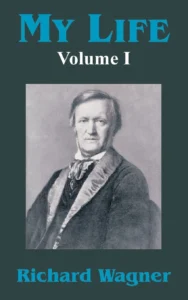
Richard Wagner: My Life — Volume I
Autobiographical Nature and Scope
My Life is Richard Wagner’s own autobiographical narrative, dictated between 1865 and 1880, largely to his second wife Cosima Wagner. Volume I covers Wagner’s life from his birth in 1813 up to the early 1840s, culminating around the period of Rienzi, The Flying Dutchman, and Tannhäuser. It is written entirely in the first person, with Wagner consciously shaping his self-image as an artist struggling against misunderstanding, hostility, and material hardship.
From the outset, Wagner presents himself not simply as a composer recounting events, but as a dramatic protagonist in his own life story. Childhood memories, family circumstances, early literary ambitions, first musical experiences, failed theatrical ventures, debts, love affairs, and artistic frustrations are all woven into a continuous narrative whose tone is often theatrical, defensive, and prophetic.
Genesis and History of the Book
The origins of My Life are inseparable from King Ludwig II of Bavaria, Wagner’s most important patron. At Ludwig’s request, Wagner began dictating his memoirs in 1865, partly as a gesture of gratitude and partly as a justification of his controversial life and artistic mission.
Key aspects of the book’s history include:
- Dictation rather than writing: Wagner dictated the text orally, which explains its expansive, rhetorical style and occasional repetitions.
- Private intention: The memoirs were not meant for immediate publication. Wagner intended them primarily for Ludwig II and a very restricted circle.
- Posthumous publication: After Wagner’s death in 1883, Cosima Wagner carefully edited and eventually authorized publication. The first complete German edition appeared in 1911, followed shortly by English translations.
Volume I thus reflects not a spontaneous diary, but a retrospective reconstruction, filtered through memory, ideology, and self-justification.
Content and Narrative Character of Volume I
In this first volume, Wagner constructs a teleological narrative: everything in his early life is presented as inevitably leading toward his later artistic revolution.
Key thematic strands include:
- Early identity formation: Wagner emphasizes his literary inclinations, fascination with drama, and early sense of destiny.
- Struggle and exile (psychological, not yet political): Financial instability, professional rejection, and failed projects dominate the narrative.
- Women and emotional entanglements: His marriage to Minna Planer is described with growing bitterness and emotional distance.
- Artistic awakening: Wagner retrospectively interprets his early works as necessary steps toward his mature conception of music drama.
The tone alternates between self-pity, defiance, irony, and prophetic confidence, often portraying Wagner as a misunderstood genius opposed by mediocrity.
Reliability and Critical Assessment
From a historical standpoint, My Life—especially Volume I—is problematic but indispensable.
Strengths:
- Provides unparalleled insight into Wagner’s self-perception.
- Offers vivid descriptions of theatrical life, musicians, and cultural conditions in early 19th-century Germany.
- Reveals the emotional and psychological mechanisms behind Wagner’s artistic development.
Limitations:
- Chronology is sometimes distorted.
- Personal responsibility is frequently minimized, while blame is shifted to others.
- Certain episodes are exaggerated, selectively remembered, or ideologically reframed.
Modern scholarship consistently treats My Life as a subjective document, to be read alongside letters, contemporary accounts, and archival sources.
Importance and Legacy
Despite its biases, My Life—and especially Volume I—remains one of the most influential autobiographies ever written by a composer.
Its importance lies in several areas:
- Understanding Wagnerian ideology: The roots of Wagner’s later aesthetic, philosophical, and political positions are already visible.
- Reception history: The book profoundly shaped how Wagner was perceived by admirers and detractors alike throughout the late 19th and early 20th centuries.
- Model of artistic self-mythologizing: Wagner sets a template later echoed by figures such as Strauss, Mahler, and even non-musical artists.
Above all, Volume I establishes Wagner’s lifelong strategy: to fuse life, art, and destiny into a single, dramatic narrative—a strategy as powerful and controversial as his music.
Overall Evaluation
My Life — Volume I is not an objective autobiography, but it is a foundational Wagnerian text. Its value does not lie in factual precision alone, but in its capacity to expose the mind of an artist who consciously constructed his own legend while still alive.
Read critically, it is indispensable. Read uncritically, it is misleading. Read intelligently, it becomes one of the most revealing documents in the history of Western music.