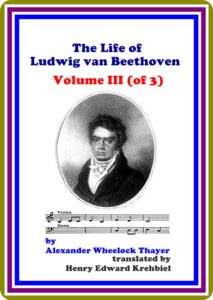
The Life of Beethoven
Researched Bibliographic Dossier
Verified edition data and a musicological research note prepared specifically for this work.
- Title
- The Life of Beethoven
- Author
- Anton Schindler
- Publisher
- Historical edition / bibliographic record
- Language
- English or original-language historical edition
- Type
- Biography / historical source
SCOPE & CONTENT
This curated dossier identifies The Life of Beethoven by Anton Schindler as a distinct Library resource and makes it discoverable through normalized title and author forms. The work is valuable as a historical source, critical study or documentary witness and belongs to the core literature surrounding musical biography, correspondence and reception.
RESEARCH VALUE
For research use, the record should be read in its historical context. Older biographies and memoir-based studies can preserve unique testimony while also reflecting the assumptions and limitations of their period. The dossier emphasizes discoverability and bibliographic identification without presenting every historical claim as current scholarly consensus.
HISTORICAL VALUE
The work is retained as part of the documentary history of classical-music scholarship and reception.
SEARCH AND CATALOGUE ROLE
Title and author aliases are stored independently from the physical filename so Library can retrieve the record even when the uploaded document has an abbreviated or inconsistent technical name.
- Format
- File size
- 2.4 MB
- Subjects / people
- Books & Essays · Composers · Ludwig van Beethoven · Biographies & Monographs
- Catalogue completeness
- 4 / 10 core bibliographic fields
Extended Editorial Dossier
Existing Classical Archive editorial content associated with this document, integrated here as reference material. File controls and direct PDF/DOC links are excluded from this bibliographic copy.
The Life of Ludwig van Beethoven, Volume III by Alexander Wheelock Thayer
Scope and historical position of Volume III
Volume III of Thayer’s biography covers the decisive years of Beethoven’s middle period, roughly from 1803 to 1816—the phase traditionally associated with the so-called “heroic” style. This is the period of the Eroica, the Fifth and Sixth Symphonies, the Violin Concerto, Fidelio, the Razumovsky Quartets, and many of the major piano works that permanently altered the expressive scale of instrumental music.
Within the architecture of Thayer’s biography, Volume III represents the point of full artistic maturity, where Beethoven’s struggle for independence, authority, and control over his own work reaches its peak.
Central argument and narrative focus
Thayer’s fundamental argument in this volume is implicit rather than polemical:
Beethoven’s greatness is inseparable from his lived historical circumstances, not from myth, legend, or Romantic abstraction.
Rather than presenting the “heroic period” as an explosion of genius detached from reality, Thayer shows it as the outcome of:
- Increasing social authority in Vienna
- A hard-won network of aristocratic patronage
- Continuous conflict with institutions (theatres, publishers, opera management)
- A growing sense of moral and artistic mission, forged in adversity
Beethoven emerges not as a tragic visionary removed from the world, but as a forceful, combative professional, determined to impose his artistic standards on performers, patrons, and institutions alike.
Beethoven as a historical individual
One of the great achievements of Volume III is Thayer’s refusal to psychologize Beethoven speculatively. Deafness, isolation, and personal difficulty are present, but they are never romanticized. Instead, Thayer documents:
- Beethoven’s assertiveness and volatility in professional dealings
- His increasing control over publication and performance
- His growing impatience with incompetence or compromise
- His ability to function publicly and creatively despite severe physical limitations
This portrait dismantles the cliché of the suffering, inwardly broken genius and replaces it with a figure of remarkable resilience, discipline, and authority.
Treatment of the works
Thayer does not provide formal musical analysis in the modern sense. Instead, he situates each major work within:
- Its occasion
- Its intended performers
- Its first reception
- Its practical difficulties
In Volume III, this approach is particularly effective for:
- Fidelio, treated as a complex institutional and theatrical problem rather than a purely artistic failure or triumph
- The symphonies, shown as public events embedded in specific concert contexts
- The string quartets, linked to aristocratic salons and patronage
Thayer’s method allows the reader to understand how these works entered the world, not merely how they function on paper.
Opinions and critical evaluation
Strengths
✔️ Unmatched documentary sobriety
✔️ Clear separation between fact, probability, and speculation
✔️ Demolition of Romantic legend surrounding the “heroic Beethoven”
✔️ A convincing portrait of Beethoven as a historical agent, not a myth
Volume III is particularly strong in showing Beethoven’s power dynamics: how he negotiated, dominated, resisted, and sometimes alienated those around him.
Where are the years 1816–1827 covered?
The Life of Ludwig van Beethoven, Volume IV
(completed posthumously)
Alexander Wheelock Thayer did not live to complete the biography. He died in 1897, having brought the narrative substantially into the mid-1810s, but without producing a final, authorial account of the last decade.
After his death:
- Hermann Deiters edited and completed the continuation
- Later, Elliot Forbes revised and expanded the English edition
As a result, the years 1816–1827 exist in Thayer’s biography, but they are editorial continuations, not purely Thayer’s own voice.
Why does Volume III seem to “stop early”?
Volume III effectively closes around 1816, when:
- Beethoven’s public career slows
- His deafness becomes nearly total
- His life turns inward, legally complex, and psychologically fragmented
Thayer had already documented:
- The heroic period
- Public authority
- Institutional power
But the late period posed problems that Thayer approached more cautiously:
- Sparse documentation
- Intimate, private suffering
- Legal entanglements (nephew Karl)
- Illness and isolation
Rather than speculate, Thayer preferred silence to conjecture.
Nature of the posthumous continuation (1816–1827)
The final period includes:
- The late piano sonatas
- The late string quartets
- The Missa solemnis
- The Ninth Symphony
- The Karl guardianship crisis
- Final illness and death
But stylistically, this section is:
- More documentary than interpretive
- Less psychologically unified
- Less philosophically shaped than Vols. I–III
It is valuable, but not artistically homogeneous with Thayer’s own writing.
Scholarly consensus (important)
Most Beethoven scholars agree:
- Volumes I–III = Thayer’s intellectual core
- Post-1816 = necessary completion, not a finished Thayerian vision
That is why many modern biographies (e.g. Solomon, Swafford, De La Grange):
- Rely heavily on Thayer for facts
- But reinterpret the late years with:
- Psychological insight
- Cultural context
- Musical analysis
So, to answer your question directly
Is Beethoven’s life from 1816 to his death not explained?
It is explained, but:
- ✔️ Not fully by Thayer himself
- ✔️ Mostly through posthumous editorial continuation
- ✔️ With less narrative unity than earlier volumes
This is not an omission, but a methodological consequence of Thayer’s death and his refusal to speculate.
Practical reading recommendation
If you want the best coverage of Beethoven 1816–1827:
- Use Thayer (Vol. IV / Forbes edition) → for documents and chronology
- Pair it with:
- Beethoven (psychological depth)
- Jan Swafford (narrative synthesis)
Final takeaway
Thayer gives us Beethoven as history up to his full public authority.
The final decade — inward, painful, revolutionary — required later voices.
Thayer built the foundation.
Others completed the house.