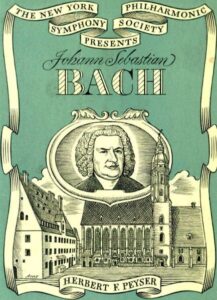
Johann Sebastian Bach
Herbert F. Peyser. Johann Sebastian Bach.
- Author / responsible person
- Herbert F. Peyser
- Language
- English
- Document type
- Book / Essay
- Format
- File size
- 941.2 KB
- Subjects / people
- Books & Essays · Composers · Johann Sebastian Bach · Essays & Reception
- Catalogue completeness
- 3 / 10 core bibliographic fields
CLASSICAL ARCHIVE EDITORIAL NOTE
Download Johann Sebastian Bach by Herbert F. Peyser — what kind of Bach book this is, and how to use it Johann Sebastian Bach by Herbert F. Peyser is a mid-20th-century narrative biography written for the cultivated general reader, not for specialists. It aims to explain Bach clearly and sympathetically, rather than to advance archival research. Authorial stance and intent Peyser was a music critic and cultural writer, closely linked to American musical journalism. His Bach is conceived as: An accessible life story A guide through Bach’s major genres A portrait that integrates religion, family, and work without technical overload He writes about Johann Sebastian Bach as a working professional—disciplined, devout, and pragmatic—rather than as a remote or mythic genius. Strengths ✔️ Clarity and readability✔️ Smooth chronological narrative (Eisenach →…
SCOPE & CONTENTS
Johann Sebastian Bach by Herbert F. Peyser is a mid-20th-century narrative biography written for the cultivated general reader, not for specialists. It aims to explain Bach clearly and sympathetically, rather than to advance archival research.
CONTEXT & SCHOLARLY RELEVANCE
Is it a good book?Yes — for its purpose. ✔️ Excellent introductory biography ✔️ Humane, balanced, and engaging ❌ Not a research reference ❌ Superseded for scholarly work
Extended Editorial Dossier
Existing Classical Archive editorial content associated with this document, integrated here as reference material. File controls and direct PDF/DOC links are excluded from this bibliographic copy.
Johann Sebastian Bach by Herbert F. Peyser — what kind of Bach book this is, and how to use it
Johann Sebastian Bach by Herbert F. Peyser is a mid-20th-century narrative biography written for the cultivated general reader, not for specialists. It aims to explain Bach clearly and sympathetically, rather than to advance archival research.
Authorial stance and intent
Peyser was a music critic and cultural writer, closely linked to American musical journalism. His Bach is conceived as:
- An accessible life story
- A guide through Bach’s major genres
- A portrait that integrates religion, family, and work without technical overload
He writes about Johann Sebastian Bach as a working professional—disciplined, devout, and pragmatic—rather than as a remote or mythic genius.
Strengths
✔️ Clarity and readability
✔️ Smooth chronological narrative (Eisenach → Weimar → Köthen → Leipzig)
✔️ Balanced tone, avoiding Romantic excess
✔️ Helpful for first encounters with Bach’s music and context
Peyser is particularly effective at:
- Explaining why Bach mattered historically
- Making large bodies of work intelligible to non-specialists
- Keeping biography and music in proportion
Limitations (important)
❌ No original source research
❌ Relies heavily on Philipp Spitta and early 20th-century German scholarship
❌ Simplifies institutional conflicts (especially Leipzig)
❌ Outdated on chronology and documentary nuance by modern standards
This is a synthesis, not an investigation.
Place within Bach biography
Peyser sits between the 19th-century monuments and modern scholarship:
- Forkel (1802) – foundational testimony
- Spitta (1873–80) – monumental, documentary
- Peyser (mid-20th c.) – readable synthesis for a broad audience
- Modern scholars – Wolff, Dürr, Rifkin, etc. (archival and institutional depth)
Overall evaluation
Is it a good book?
Yes — for its purpose.
- ✔️ Excellent introductory biography
- ✔️ Humane, balanced, and engaging
- ❌ Not a research reference
- ❌ Superseded for scholarly work
Final verdict
Herbert F. Peyser’s Johann Sebastian Bach remains worth reading as a clear, cultured introduction and as a document of mid-20th-century Bach reception. It helps readers enter Bach’s world gracefully—but it should be complemented by modern scholarship for factual precision.