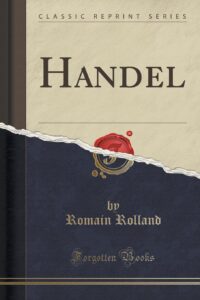
Handel
Researched Bibliographic Dossier
Verified edition data and a musicological research note prepared specifically for this work.
- Title
- Handel
- Author
- Romain Rolland
- Publisher
- Henry Holt / historical English edition
- Year
- 1911
- Language
- English
- Type
- Biography / critical essay
SCOPE & CONTENT
This dossier covers Handel, a significant bibliographic resource associated with Romain Rolland. The volume is useful because it helps place its subject within a wider historical, analytical or documentary context and complements the rest of the Library catalogue with a clearly identified title-and-author record.
RESEARCH VALUE
For research purposes, the main value of the book lies in making a specific strand of scholarship or testimony easier to identify from Library search. It should be read together with more recent studies and source-based work when the subject has generated substantial later bibliography, but it remains an important point of orientation for users interested in handel.
DISCOVERABILITY AND MATCHING
The curated record preserves core bibliographic metadata and broadens discoverability by normalizing title and author variants, so the work can be found even when the physical PDF filename is abbreviated or technically inconsistent.
RESEARCH USE
The dossier is designed as a non-destructive enrichment layer: it does not alter or rename the underlying document, and verified fields are only copied into empty catalogue metadata when a physical attachment can be matched safely.
- Format
- File size
- 4.9 MB
- Subjects / people
- Books & Essays · Composers · George Frideric Handel · Essays & Reception
- Catalogue completeness
- 5 / 10 core bibliographic fields
Extended Editorial Dossier
Existing Classical Archive editorial content associated with this document, integrated here as reference material. File controls and direct PDF/DOC links are excluded from this bibliographic copy.
Handel by Romain Rolland is not a scholarly biography in the modern sense, but it is one of the most influential literary portraits of Handel ever written. Its importance lies less in documentation than in interpretation, vision, and cultural impact.
Authorial perspective and intention
Romain Rolland was:
- A writer, intellectual, and humanist
- Deeply engaged with music as a moral and spiritual force
- Not an archivist or source critic
His Handel book belongs to the same family as his famous studies of Beethoven:
➡️ biography as moral portrait, not as historical reconstruction.
Rolland writes about Handel as:
- A heroic creative force
- A figure of resilience and vitality
- A composer embodying strength, generosity, and human breadth
Strengths of the book
✔️ Exceptional literary quality
✔️ Powerful, memorable characterization of Handel
✔️ Deep intuition for:
- Artistic temperament
- Creative energy
- Psychological resilience
✔️ Places Handel within a pan-European humanistic tradition, not a narrow national frame
Rolland’s Handel is:
- Expansive
- Life-affirming
- Closely linked to the ideals of freedom, dignity, and inner strength
For many readers, this book is what made Handel feel alive and modern.
Major limitations (essential to understand)
❌ Not source-critical
❌ Relies heavily on earlier biographies (Mainwaring, Schoelcher, Spitta-era tradition)
❌ Tolerates anecdote and legend
❌ Chronology and factual precision are secondary
Rolland is not interested in:
- Verifying documents
- Weighing conflicting evidence
- Institutional or economic context
For him, symbolic truth matters more than factual exactitude.
Place within Handel biography (historical map)
Rolland occupies a unique but clearly defined position:
- 19th century → anecdotal / heroic tradition
- Romain Rolland → literary-humanistic synthesis
- Edward J. Dent → first modern critical break
- Winton Dean / Burrows → scholarly consolidation
Rolland is not surpassed by Dent in documentation—he is superseded by design.
Comparison with other Handel biographies
- Compared to Dent:
- Less accurate
- More emotionally persuasive
- Compared to Winton Dean:
- Non-analytical
- Much more poetic
- Compared to Burrows:
- Not comparable in method
- Complementary in spirit only
Rolland explains why Handel matters, not how his career unfolded in detail.
When is this book worth reading today?
✔️ If you want a deeply felt portrait of Handel
✔️ If you value literary insight over documentation
✔️ As a counterweight to dry scholarship
✔️ For understanding early 20th-century humanist reception of Handel
❌ Not suitable as a factual reference
❌ Not sufficient for academic study
Overall evaluation
Is it a good book?
Yes — if read for what it is.
- ✔️ A great literary biography
- ✔️ Culturally influential
- ✔️ Psychologically suggestive
- ❌ Historically unreliable in detail
Final verdict
Romain Rolland’s Handel is not a book you consult—it is a book you experience.
It does not teach you the facts of Handel’s life with precision, but it can teach you why Handel’s music radiates strength, confidence, and generosity.
Used alongside Dent or Burrows, it becomes enriching rather than misleading.