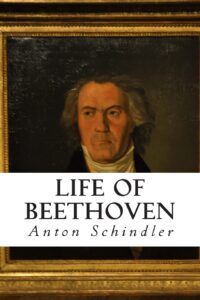
The Life of Beethoven
Researched Bibliographic Dossier
Verified edition data and a musicological research note prepared specifically for this work.
- Title
- The Life of Beethoven
- Author
- Anton Schindler
- Publisher
- Historical edition / bibliographic record
- Language
- English or original-language historical edition
- Type
- Biography / historical source
SCOPE & CONTENT
This curated dossier identifies The Life of Beethoven by Anton Schindler as a distinct Library resource and makes it discoverable through normalized title and author forms. The work is valuable as a historical source, critical study or documentary witness and belongs to the core literature surrounding musical biography, correspondence and reception.
RESEARCH VALUE
For research use, the record should be read in its historical context. Older biographies and memoir-based studies can preserve unique testimony while also reflecting the assumptions and limitations of their period. The dossier emphasizes discoverability and bibliographic identification without presenting every historical claim as current scholarly consensus.
HISTORICAL VALUE
The work is retained as part of the documentary history of classical-music scholarship and reception.
SEARCH AND CATALOGUE ROLE
Title and author aliases are stored independently from the physical filename so Library can retrieve the record even when the uploaded document has an abbreviated or inconsistent technical name.
- Format
- File size
- 3.9 MB
- Subjects / people
- Books & Essays · Composers · Ludwig van Beethoven · Essays & Reception
- Catalogue completeness
- 4 / 10 core bibliographic fields
Extended Editorial Dossier
Existing Classical Archive editorial content associated with this document, integrated here as reference material. File controls and direct PDF/DOC links are excluded from this bibliographic copy.
Overview, scope, historical value, and controversies
Life of Beethoven is one of the earliest and most influential 19th-century biographies of Ludwig van Beethoven, written by a man who claimed personal closeness to the composer during his final years. First issued in 1840 (with expanded editions in 1845 and 1860), the book shaped how generations imagined Beethoven’s character, habits, and daily life—often more powerfully than any later scholarly study.
Author and context
Anton Schindler (1795–1864) knew Beethoven in Vienna during the late 1820s and served intermittently as an assistant and companion. After Beethoven’s death (1827), Schindler positioned himself as a privileged witness to the composer’s private world. His biography appeared at a time when Romantic culture craved intimate portraits of genius, and Schindler’s narrative—rich in anecdote—met that demand perfectly.
What the book covers
1) A life told through proximity
Schindler presents Beethoven’s story from within: conversations, moods, irritations, humor, routines, and moral convictions. The narrative foregrounds personality and character as much as chronology.
2) Anecdotes and daily habits
The book abounds in scenes of everyday life—Beethoven’s walks, dietary quirks, temper, work habits, and social awkwardness—many of which entered the cultural bloodstream through Schindler’s pages.
3) Artistic ideals and intentions
Schindler frequently reports Beethoven’s spoken views on music, aesthetics, and ethics, portraying him as a morally serious, inwardly driven artist who saw composition as a higher calling.
4) The late years
Particular emphasis is placed on the final decade: illness, deafness, isolation, and the creation of the late works, framed as the summit of spiritual struggle and transcendence.
Style and approach
- Narrative-driven and memoir-like, not archival
- Confident authorial voice, often asserting authority through proximity
- Selective documentation; citations are rare by modern standards
- Written for a broad, cultivated 19th-century readership rather than specialists
Reception and long-term impact
Immediate influence
Upon publication, Schindler’s biography was hugely influential. It helped canonize the image of Beethoven as a stormy, solitary, morally elevated genius—an image that resonated with Romantic ideals.
The problem of reliability
From the late 19th century onward—and decisively in the 20th—scholars uncovered serious credibility issues:
- Fabricated or altered entries in Beethoven’s Conversation Books
- Self-aggrandizing claims of intimacy and influence
- Anecdotes that cannot be corroborated by independent sources
As a result, the book is now treated as a problematic primary source: indispensable for reception history, unsafe as factual evidence unless corroborated.
How scholars use the book today
Modern Beethoven studies do not discard Schindler, but contextualize him:
- As a witness to how Beethoven was remembered and mythologized shortly after his death
- As a source for period attitudes toward genius, suffering, and artistic vocation
- As a cautionary example of memory, ego, and narrative shaping history
Schindler’s biography is often read alongside later, more rigorous works to understand what was believed, what was invented, and why those inventions endured.
Why the book still matters
Despite its flaws, Life of Beethoven remains essential because:
- It founded the Beethoven myth that dominated the 19th century
- It influenced composers, performers, and writers for generations
- It reveals how biography can create legend as much as record fact
For readers and researchers, the book is best approached as a historical document of reception, not a neutral chronicle.
Recommended way to read it today
- Read critically, with awareness of Schindler’s motives
- Cross-check anecdotes against modern scholarship
- Value it for insight into Beethoven’s posthumous image, not for precise documentation
In short
Life of Beethoven by Anton Schindler is foundational, vivid, and deeply flawed—a work that shaped Beethoven’s legend more than it established his facts. Understanding Beethoven’s afterlife in culture is impossible without it, but understanding Beethoven himself requires reading it with caution and context.