Johannes Brahms by Heather Platt
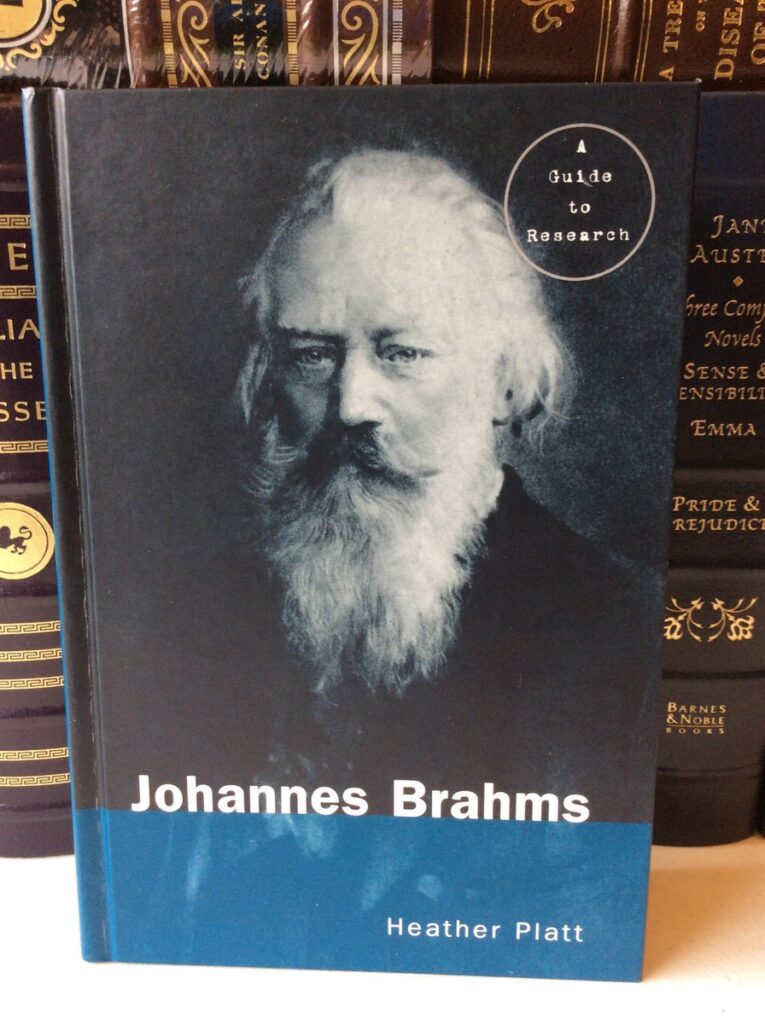
Bibliographical details
- Author: Heather Platt
- Publisher: Routledge
- First publication: 2012
- Series: Routledge Composer Biographies
- Length: approximately 240–260 pages, depending on the edition
The book was conceived as a modern, academically grounded biography, intended for readers who want a reliable overview of Brahms’s life integrated with musical and cultural context, rather than a monumental documentary study.
The Author: Heather Platt
Heather Platt is a British musicologist and academic, widely respected for her research on nineteenth-century German music, with particular focus on Brahms, Schumann, and issues of musical identity and historicism.
She has held teaching and research posts at major universities in the United Kingdom and has published extensively on:
- Brahms’s relationship to musical tradition
- The concept of historical consciousness in 19th-century music
- German musical culture and aesthetics
Platt belongs to a generation of scholars who combine archival awareness with cultural and analytical interpretation, avoiding both Romantic mythmaking and purely technical formalism.
Approach and structure of the book
Johannes Brahms by Heather Platt is organized chronologically, but each life period is interpreted through thematic lenses, such as:
- Brahms’s formation in Hamburg
- His complex relationship with Schumann and the idea of musical inheritance
- His engagement with historical forms (variation, fugue, sonata)
- His position within the so-called “progressive vs. conservative” debate of the 19th century
Rather than treating Brahms as either a reactionary or a modernist in disguise, Platt presents him as a composer deeply aware of the past yet creatively reworking it.
Portrait of Brahms
Brahms emerges as:
- Intellectually rigorous and self-critical
- Emotionally reserved, yet deeply expressive in music
- Highly conscious of tradition and historical responsibility
- Resistant to public self-mythologizing
Platt avoids anecdotal excess and psychological speculation. Instead, Brahms’s character is inferred from professional choices, compositional decisions, and correspondence, always with attention to historical plausibility.
Music and interpretation
Musical discussion in the book is selective and focused, not exhaustive. Major works—symphonies, chamber music, piano music, and songs—are discussed insofar as they illuminate:
- Brahms’s compositional priorities
- His dialogue with Beethoven and earlier composers
- His refinement of large-scale form and motivic economy
The emphasis is on musical thought rather than technical minutiae, making the book accessible to informed readers without requiring advanced theoretical training.
Position within Brahms literature
This biography occupies a middle ground between:
- Large-scale documentary lives (such as Swafford or Bozarth-era studies)
- Introductory popular biographies
Its strengths lie in:
- Clarity and balance
- Integration of life, works, and cultural context
- A modern scholarly perspective free of Romantic exaggeration
In summary
Heather Platt’s Johannes Brahms is a clear, intelligent, and reliable modern biography, ideally suited for readers seeking a contextual and musically informed portrait of Brahms. It presents him not as a monument or a mystery, but as a historically conscious artist whose originality lies in depth, discipline, and continuity.