Great Operas – A Guide to Twenty-Five of the World’s Finest Musical Experiences – Michael Steen
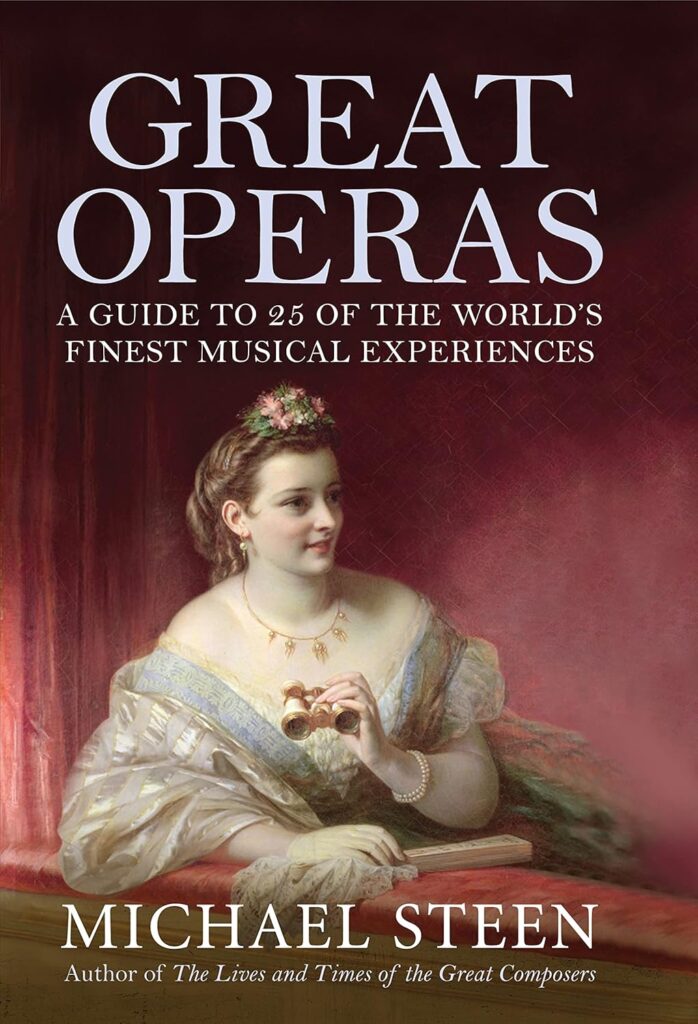
Great Operas – A Guide to Twenty-Five of the World’s Finest Musical Experiences
Great Operas – A Guide to Twenty-Five of the World’s Finest Musical Experiences by Michael Steen is conceived not as a catalogue or synopsis manual, but as a guided journey through twenty-five operatic encounters chosen for their power as lived theatrical experiences. Steen writes for readers who already sense that opera is more than repertory—that certain works, when fully realised, become events that mark a listener for life.
Conception and Writing
- Date of composition: early 2000s
- Written at a moment when:
- historically informed performance and modern staging coexisted
- recordings were abundant, yet live experience remained central
- Steen’s aim was selective and qualitative: to slow the reader down, to ask not “Which operas are important?” but “Which operas, when done well, are unforgettable?”
This deliberate limitation to twenty-five works gives the book its reflective, almost curatorial tone.
First Publication
- First publication: 2004
- Publisher: Thames & Hudson
- Place of publication: London
The choice of Thames & Hudson is telling: the book was designed as a serious but accessible cultural object, combining authoritative prose with a visually appealing layout.
Editions and Formats
- Original edition: 2004 (hardcover)
- Subsequent reprints: mid-2000s onward
- Formats: print (hardback; later paperback editions in some markets)
There is no radically revised second edition; the book stands as a stable statement of taste and perspective.
Structure and Approach
Each of the twenty-five operas is treated as a complete artistic world. Rather than act-by-act synopsis, Steen offers:
- historical and aesthetic context
- explanation of dramatic stakes
- discussion of musical architecture without technical overload
- reflections on why the opera succeeds in performance, not merely on paper
The emphasis is consistently on experience: pacing, tension, atmosphere, and emotional payoff.
Repertoire and Perspective
Steen’s selection balances:
- canonical masterpieces
- operas whose greatness depends heavily on interpretation
He avoids encyclopaedism in favour of depth, encouraging readers to engage intensely with a smaller number of works rather than skim hundreds.
The book implicitly argues that opera appreciation matures not through accumulation, but through repeated, attentive encounters.
Tone and Style
The prose is:
- calm, confident, and reflective
- informed by scholarship but free of academic display
- written for the cultivated listener rather than the specialist
Steen positions himself as a thoughtful guide, not a provocateur or polemicist.
Why the Book Matters
Great Operas fills a distinctive niche between:
- popular plot guides
- academic histories
Its lasting value lies in its philosophy of listening. It reminds readers that opera’s greatness is not abstract or guaranteed—it emerges only when music, drama, performers, and audience align.
Bibliographic Summary
- Author: Michael Steen
- Title: Great Operas – A Guide to Twenty-Five of the World’s Finest Musical Experiences
- Composition: early 2000s
- First publication: 2004
- Publisher: Thames & Hudson (London)
- Editions: original hardcover; later reprints
- Genre: selective opera guide / interpretive commentary
Final Perspective
This is a book about quality over quantity, depth over breadth. Steen invites readers to listen more attentively, to recognise when an opera transcends repertoire and becomes an experience that lingers—emotionally, intellectually, and imaginatively.