Great Italian and French Composers, by George T.Ferris
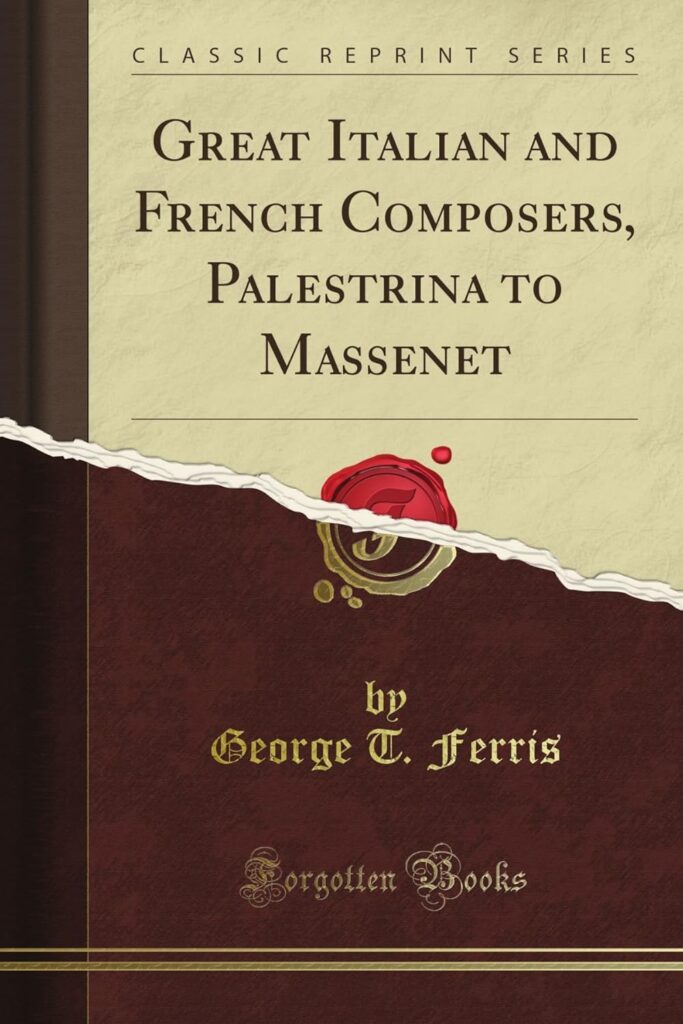
Great Italian and French Composers is a 19th-century biographical and critical survey written by the American music historian George T. Ferris, best known for his series of popular books introducing European classical music to the English-speaking public. The volume belongs to a broader cycle that includes works on German composers and the great masters of music history.
Historical Context and Purpose
Published in the late 1800s, this book was conceived at a time when:
- systematic musicology was still in its infancy
- English-language readers had limited access to European musical scholarship
- biography was often mixed with aesthetic judgment and moral reflection
Ferris’s aim was educational and divulgative: to present the great operatic and sacred composers of Italy and France in a clear, engaging narrative, accessible to cultivated but non-specialist readers.
Scope and Composers Covered
The book focuses primarily on composers associated with opera and vocal music, including figures such as:
- Giovanni Pierluigi da Palestrina
- Claudio Monteverdi
- Jean-Baptiste Lully
- Jean-Philippe Rameau
- Christoph Willibald Gluck
- Gioachino Rossini
- Gaetano Donizetti
- Vincenzo Bellini
- Giacomo Meyerbeer
Ferris is particularly interested in opera as a cultural force, treating Italian lyricism and French theatrical refinement as complementary traditions rather than rivals.
Style and Method
Ferris writes in a fluent, Victorian prose style, characterized by:
- narrative biography
- vivid anecdote
- moral and aesthetic evaluation
- limited technical musical analysis
The emphasis lies on:
- character and temperament
- dramatic instinct
- national style
- historical influence
Rather than close score analysis, Ferris prefers broad stylistic portraits and comparisons.
Critical Perspective
From a modern standpoint, the book reflects:
- 19th-century aesthetic hierarchies
- admiration for melodic gift and dramatic clarity
- occasional moralizing tone
- a tendency to frame composers as “great men” of history
While some judgments are now dated, they are valuable as documents of reception history, showing how Italian and French composers were understood by educated Anglo-American readers of the time.
Scholarly Value Today
Today, Great Italian and French Composers is valued not as a primary academic source, but as:
- a historical reference for 19th-century musical taste
- a readable introduction to operatic traditions
- a source of period anecdotes and critical attitudes
- a useful complement to modern musicological studies
It is especially interesting when read alongside later, more rigorous scholarship, highlighting how narrative biography preceded analytical musicology.
Limitations
- outdated factual information in places
- absence of modern source criticism
- minimal engagement with manuscripts or archival evidence
These limitations are typical of its era and do not diminish its historical interest.
Conclusion
George T. Ferris’s Great Italian and French Composers stands as a representative Victorian synthesis of biography, criticism, and cultural history. While superseded by modern scholarship, it remains a valuable window into how opera and its creators were perceived in the 19th century, and a useful, engaging read for those interested in the evolution of musical historiography.