Franz Schubert, A Biography – Elizabeth Norman McKay
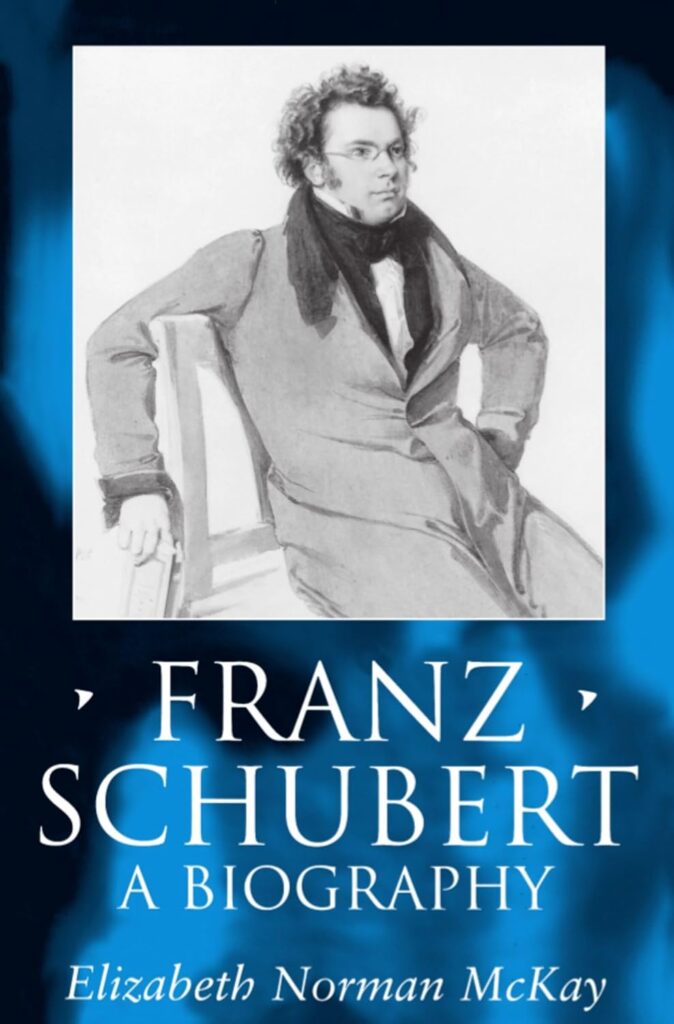
Franz Schubert: A Biography by Elizabeth Norman McKay is widely regarded as one of the most authoritative, balanced, and readable modern biographies of Franz Schubert. First published in the late 20th century and later revised, it successfully unites rigorous scholarship with a clear narrative style, making it indispensable both to specialists and to serious general readers.
Author and Scholarly Authority
Elizabeth Norman McKay was a distinguished British musicologist with particular expertise in:
- Viennese musical life
- Schubert’s documentary sources
- critical reassessment of 19th-century biographical myths
Her work is grounded in letters, diaries, court records, and early testimonies, carefully separating documented fact from later romanticized legend.
Purpose and Method
McKay’s biography aims to:
- reconstruct Schubert’s life chronologically and contextually
- integrate social, economic, and cultural realities
- connect life events directly to specific works and compositional phases
- correct persistent misconceptions (poverty, isolation, passivity)
The tone is measured, humane, and analytically alert, avoiding both sentimental exaggeration and cold positivism.
Early Life and Formation
The book gives particular clarity to:
- Schubert’s family background and education
- his years at the Stadtkonvikt
- early exposure to Haydn, Mozart, and Beethoven
- the rapid emergence of his song-writing genius
McKay emphasizes that Schubert’s development was extraordinarily precocious, yet firmly embedded in Vienna’s institutional musical culture.
Vienna, Friends, and the “Schubertians”
One of the biography’s strongest sections concerns:
- Schubert’s circle of friends
- the role of private salons and informal gatherings
- the social function of the Schubertiads
McKay shows that Schubert was not a solitary outsider, but an active participant in a vibrant intellectual and artistic network—though one with limited access to elite patronage.
Career Struggles and Professional Reality
Rather than portraying Schubert as merely unlucky, the book explains:
- the structural obstacles facing a composer without opera-house access
- difficulties with publishers
- the mismatch between Schubert’s genius and the concert economy of Vienna
This analysis is one of the biography’s great strengths, replacing tragedy-driven narratives with historical realism.
Illness, Late Style, and Inner Life
McKay treats Schubert’s illness with:
- medical caution
- documentary restraint
- avoidance of speculative psychologizing
At the same time, she offers profound insight into:
- the intensification of expression after 1823
- the emergence of the late style
- the emotional and formal depth of the final sonatas, quartets, and songs
Death and Posthumous Reputation
The biography traces:
- Schubert’s death in 1828
- early neglect and misunderstanding
- gradual canonization in the 19th century
McKay pays close attention to how later generations reshaped Schubert’s image, often projecting Romantic ideals backward.
Scholarly Importance
This biography is valued for:
- documentary reliability
- clear correction of myths
- balanced psychological portrait
- seamless integration of life and works
It stands alongside Otto Erich Deutsch and Brian Newbould as a cornerstone of modern Schubert scholarship.
Limitations
- less overtly literary than some narrative biographies
- restrained emotional tone
- prioritizes clarity over dramatic storytelling
These qualities are precisely why it remains academically trusted.
Conclusion
Elizabeth Norman McKay’s Franz Schubert: A Biography presents Schubert as neither saint nor victim, but as a fully realized historical individual—socially embedded, professionally ambitious, and artistically inexhaustible. It is one of the most reliable and humane portraits of Schubert ever written.