Franz Liszt and his World , edited by Christopher H.Gibbs ans Dana Gooley
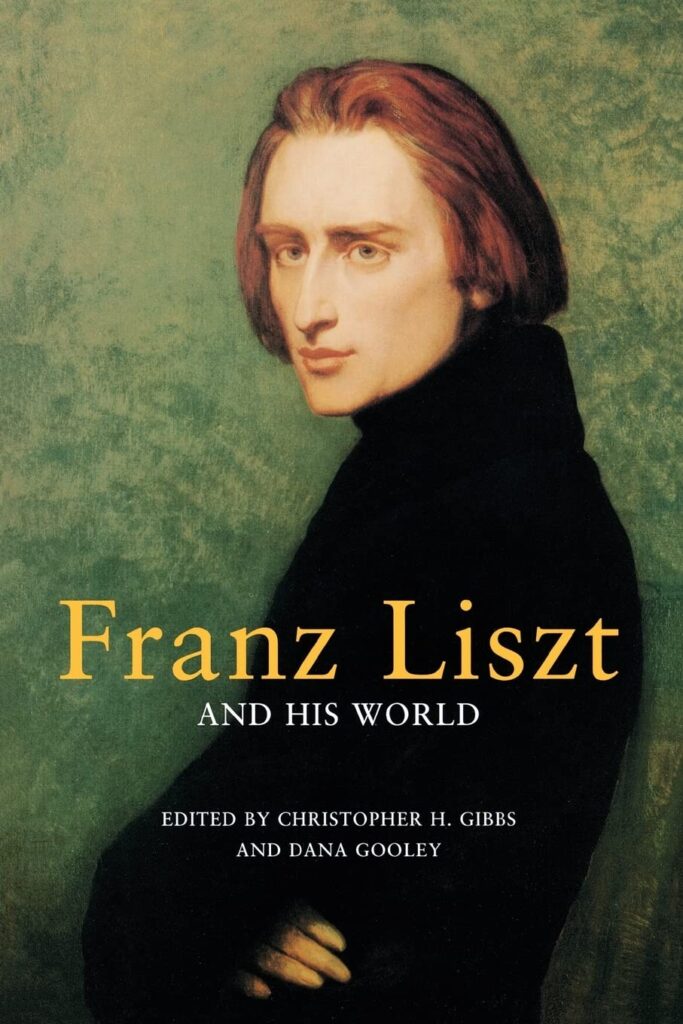
Franz Liszt and His World is a major scholarly essay collection devoted to Franz Liszt, published by Princeton University Press as part of the influential “His World” series. Rather than presenting a linear biography, the volume reconstructs Liszt’s cultural, social, intellectual, and artistic environments, offering a multifaceted portrait of one of the most complex figures of the 19th century.
Editorial Concept and Aim
Under the editorship of Christopher H. Gibbs and Dana Gooley, the book adopts a contextual, interdisciplinary approach. Liszt is examined not merely as a virtuoso pianist or prolific composer, but as:
- a cultural mediator across Europe
- a public intellectual
- a network-builder linking composers, poets, philosophers, and patrons
- a figure whose life intersected music, religion, politics, and ideology
The guiding principle is that Liszt’s music and persona cannot be understood apart from his world.
Structure and Themes
The volume is organized around thematic clusters of essays, combining musicology, cultural history, reception studies, and documentary analysis.
1. Virtuosity and Celebrity
Several essays examine Liszt as the first modern musical superstar:
- the phenomenon of “Lisztomania”
- the construction of public image
- the transformation of the piano recital into a quasi-theatrical event
Liszt emerges as a pioneer of musical celebrity culture, anticipating modern performance practices.
2. Weimar and the Idea of the “Artist-Prophet”
Liszt’s years in Weimar are treated as a turning point:
- his advocacy for new music (Berlioz, Wagner)
- the concept of the composer as moral and spiritual guide
- the institutional role of the conductor-composer
Here Liszt appears as a visionary reformer, not merely a virtuoso in retirement.
3. Religion, Philosophy, and Late Style
The volume devotes serious attention to Liszt’s:
- religious commitments
- theological thinking
- late experimental works
Rather than dismissing the late style as eccentric, contributors show it to be a laboratory of modern musical thought, anticipating Debussy, Bartók, and even early modernism.
4. Transcription, Translation, and Mediation
Essays explore Liszt’s vast output of:
- transcriptions
- paraphrases
- adaptations
These are presented not as secondary works, but as acts of cultural transmission, allowing music to circulate across social and geographic boundaries.
5. Politics, National Identity, and Europe
Liszt’s shifting relationship to:
- Hungary
- France
- Germany
- Italy
is analyzed in depth. The book reveals Liszt as fundamentally European, resisting narrow nationalist labels while engaging deeply with questions of identity and belonging.
Documents and Reception
As is typical of the “His World” series, the volume includes:
- selected letters
- contemporary criticism
- memoir fragments
These documents illuminate how Liszt was perceived during his lifetime and how his image evolved after his death.
Scholarly Importance
Franz Liszt and His World is valued for:
- its breadth of cultural context
- its revisionist reassessment of Liszt’s late music
- its integration of performance, ideology, and aesthetics
- its challenge to simplistic narratives of virtuosity
It complements traditional biographies (such as those by Alan Walker) by focusing on context rather than chronology.
Limitations
- assumes familiarity with Liszt’s life and works
- uneven density between essays (inevitable in multi-author volumes)
- less suitable as an introductory biography
These are inherent features of the format, not flaws.
Conclusion
Franz Liszt and His World presents Liszt as a composer whose influence extended far beyond his compositions—into performance culture, intellectual life, and the very idea of what it meant to be an artist in the 19th century. It is one of the most illuminating contextual studies of Liszt available and an essential complement to narrative biographies.