Emblems of Eloquence – Opera and Women Voices in XVII Century Venice – Wendy Heller
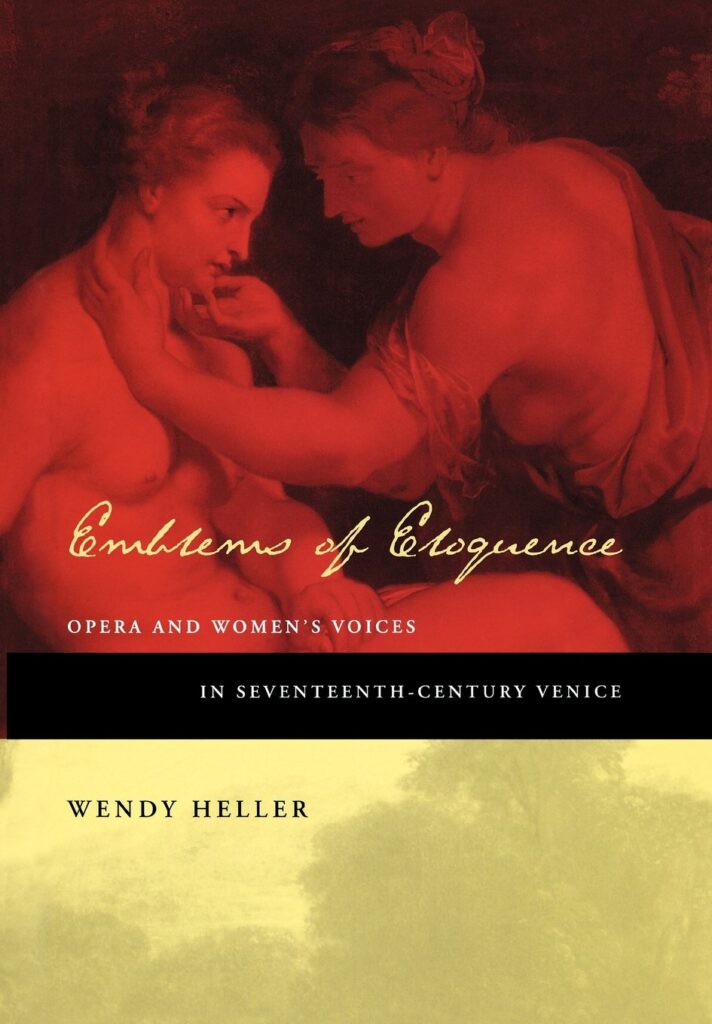
History, conception, and scholarly significance
Emblems of Eloquence: Opera and Women’s Voices in Seventeenth-Century Venice is a landmark study that fundamentally reshaped how early opera—and especially the role of women within it—is understood. Rather than treating female singers as marginal or anecdotal figures, the book places women’s voices at the very center of Venetian operatic culture, arguing that they were crucial agents in the creation, success, and dissemination of opera as a public art form.
Origins of the project
The book emerged from a broader reorientation in late-20th-century musicology toward social history, gender studies, and archival research. For decades, early Venetian opera had been discussed primarily through:
- composers (Monteverdi, Cavalli, Cesti),
- librettists,
- patrons and theaters.
Glixon and Heller recognized that this approach left a critical blind spot: the professional female singers who animated the operatic stage, shaped audience expectations, and influenced compositional style.
Their work is grounded in extensive archival research in Venetian legal, theatrical, and financial records—contracts, payment registers, correspondence, censorship documents—many of which had never been systematically examined in relation to performance practice.
Central thesis
The book’s core argument is that women singers in 17th-century Venice were not passive executants, but eloquent performers whose voices carried social, rhetorical, and symbolic power.
The term “emblems of eloquence” refers to the way female voices functioned as:
- rhetorical instruments,
- embodiments of affect and persuasion,
- public symbols of virtuosity, sensuality, and authority.
Opera, in this view, becomes a space where gender, voice, spectacle, and rhetoric intersect.
Venice as a unique environment
Venice occupies a special place in the history of opera:
- the first city with public, ticket-selling opera houses,
- a republic with a complex relationship to morality, spectacle, and commerce,
- a city where women could achieve public musical prominence unavailable elsewhere in Europe.
The book shows how Venice’s theatrical economy created unprecedented opportunities for women, while simultaneously exposing them to moral scrutiny, regulation, and stereotyping.
Women singers as cultural actors
Rather than focusing exclusively on famous figures, the authors reconstruct a network of professional women singers, examining:
- their careers and mobility,
- their salaries and contracts,
- their reputations and public images,
- their relationships with patrons, composers, and impresarios.
These singers shaped:
- vocal writing and ornamentation,
- character types and dramatic expectations,
- the balance between text, affect, and spectacle.
Opera roles were often tailored to specific women, making singers co-creators of operatic meaning, not merely interpreters.
Rhetoric, voice, and power
A major contribution of the book is its integration of rhetorical theory. Glixon and Heller connect operatic singing to:
- classical rhetoric,
- early modern ideas of persuasion and affect,
- the social meanings attached to female speech and song.
Women’s voices were celebrated for their expressive power, yet simultaneously feared for their ability to move, seduce, and destabilize audiences. Opera thus becomes a site of cultural tension between admiration and anxiety.
Impact on opera studies
Since its publication, Emblems of Eloquence has become:
- a foundational text in early opera studies,
- a standard reference in gender and musicology,
- essential reading for understanding Venetian operatic culture beyond composers alone.
It helped shift the field away from composer-centered narratives toward performance-centered history, influencing later work on singers, embodiment, and reception.
Publication data
- First publication: 2010
- Publisher: University of California Press (Berkeley, Los Angeles & London)
- Format: Hardcover (initial), later paperback and digital editions
- Scholarly context: Early opera, gender studies, performance history
- Textual status: No substantially revised later edition; the book remains authoritative and current.
Assessment
Emblems of Eloquence is not only a study of women in opera, but a redefinition of early operatic history itself. By restoring women’s voices—literally and metaphorically—to the center of Venetian opera, the book reveals opera as a genre shaped as much by performers and social dynamics as by composers and scores.
Below are 10 women—singers and composers—mentioned or discussed in Emblems of Eloquence: Opera and Women’s Voices in Seventeenth-Century Venice, identified as central figures in Venetian operatic culture or as key precedents for the rhetorical and professional authority of women’s voices in the 17th century:
- Barbara Strozzi
Venetian composer and singer; a pivotal figure in the book as an example of female authorship, musical rhetoric, and public self-representation. - Anna Renzi
The most celebrated soprano of Seicento Venice; a model of dramatic intelligence and virtuoso expressivity on the public operatic stage. - Antonia Coresi
A leading operatic star in Venice, known for her commanding stage presence and role in shaping female celebrity in early opera. - Giulia Masotti
A soprano documented in theatrical contracts and financial records; emblematic of professional female musicianship within the Venetian operatic economy. - Lucia Rubini
A singer active across several public theaters, illustrating the mobility and social visibility of professional women performers. - Maddalena Manelli
A performer associated with roles of intense affect; cited in relation to the rhetoric of emotional expression on the Venetian stage. - Francesca Caccini
Though primarily associated with Florence, she appears as a crucial precedent for the composer-performer model and the rhetorical power of the female voice. - Vittoria Archilei
An early exemplar of expressive singing (stile rappresentativo), influential for later developments in Venetian operatic vocality. - Caterina Martinelli
Closely associated with Monteverdi; key to understanding the transition from courtly music to public opera. - Francesca Campana
An operatic singer cited in discussions of performer circulation between cities and theaters in 17th-century Italy.