Beethoven’s Symphonies Critically Discussed by Alexander Teetgen
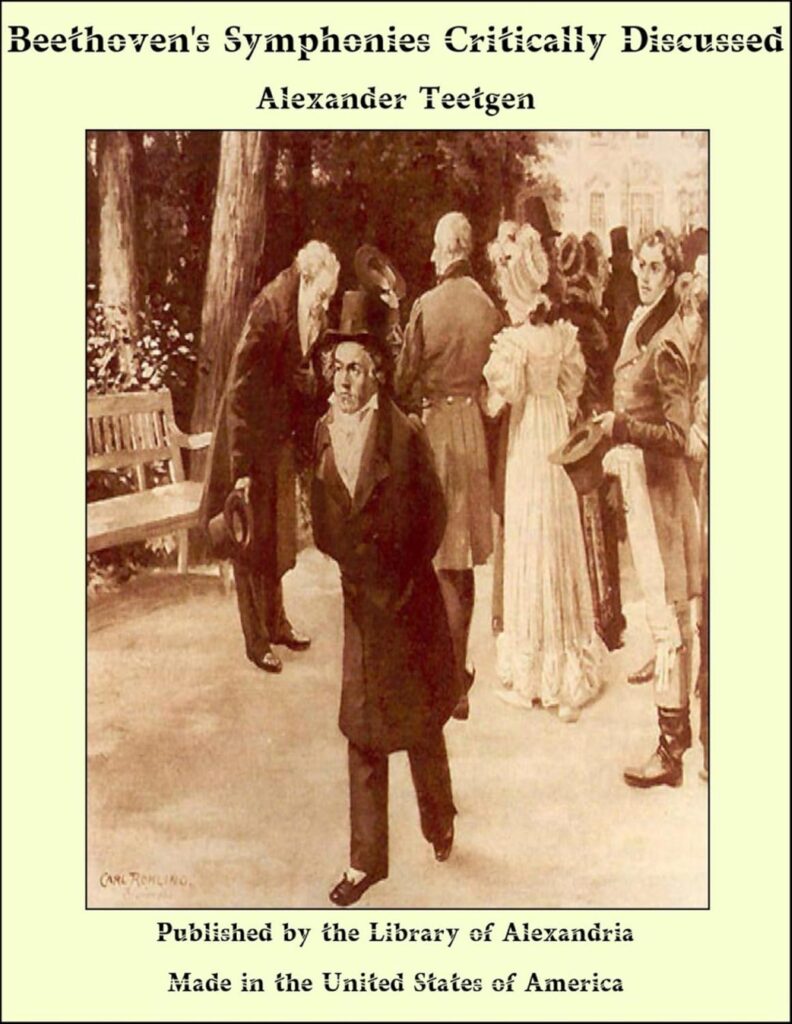
Beethoven’s Symphonies Critically Discussed by Alexander Teetgen — An Early Analytical English Perspective
Beethoven’s Symphonies Critically Discussed by Alexander Teetgen belongs to the late-19th-century English tradition of Beethoven criticism, a period when Beethoven’s symphonies had already achieved canonical status, yet systematic analytical writing in English was still developing its own voice, distinct from German musicology.
Teetgen’s book does not aim to be a biography of Beethoven, nor a purely technical treatise. Instead, it occupies an intermediate and highly revealing position: it is an attempt to explain Beethoven’s symphonies as living musical organisms, addressing both their formal construction and their expressive meaning, while remaining accessible to cultivated listeners rather than specialists alone.
Historical Context
By the time Teetgen wrote this book, Beethoven’s nine symphonies were firmly established as the central pillars of the orchestral repertoire. However, in the English-speaking world, critical engagement with them often remained impressionistic, rhetorical, or reverential rather than analytical.
German writers such as A. B. Marx had already laid the groundwork for formal and thematic analysis, while later scholars would approach Beethoven through historical, philosophical, and structural lenses. Teetgen stands at a crossroads: he translates continental analytical thought into an English critical idiom, still marked by Victorian prose and moral seriousness.
Purpose and Method
Teetgen’s central aim is to guide the listener through each symphony individually, explaining:
- its general character and expressive intent
- its formal innovations
- its thematic relationships
- its place within Beethoven’s artistic development
Rather than overwhelming the reader with technical detail, he adopts a discursive, essay-like style, moving between musical description, aesthetic judgment, and broader reflection. Musical terminology is used, but rarely in a forbidding way.
The book assumes an intelligent reader who knows the symphonies aurally, perhaps from concert attendance, and seeks deeper understanding rather than academic instruction.
The Symphonies as Teetgen Sees Them
Teetgen treats each symphony as a distinct psychological and artistic statement, not merely as steps in a linear progression. While he acknowledges Beethoven’s development from Classical inheritance toward Romantic expansion, he resists reducing the cycle to a simplistic narrative of “early–middle–late”.
Several recurring ideas shape his discussion:
- Beethoven as a composer of moral seriousness, not decorative beauty
- The symphony as a dramatic form, capable of conflict, tension, and resolution
- The importance of thematic unity and transformation
- Beethoven’s increasing tendency to push formal boundaries from within
The Eroica, Fifth, and Ninth Symphonies naturally receive particular attention, but Teetgen also takes care to defend the individuality of works often treated as transitional, such as the First, Second, and Fourth.
Style and Critical Voice
The tone of the book is unmistakably Victorian: earnest, respectful, and at times rhetorical. Beethoven appears as a heroic artistic figure, whose struggles and triumphs are mirrored in the music. Yet Teetgen avoids empty hero worship. He is willing to question, compare, and evaluate, even when writing about canonical masterpieces.
What distinguishes Teetgen is his effort to connect musical structure with emotional meaning, without collapsing one into the other. He does not treat form as dry architecture, nor emotion as vague atmosphere, but seeks to show how Beethoven’s ideas gain power precisely through their structural realization.
Strengths of the Book
- One of the earlier English books devoted exclusively to Beethoven’s symphonies
- Clear, listener-oriented analytical writing
- Balanced attention to both formal design and expressive character
- Useful insight into how Beethoven was understood in late-19th-century England
For modern readers, the book’s greatest value lies not only in what it explains, but in how it explains — revealing an historical stage in Beethoven interpretation before modern musicology, structural analysis, and historically informed performance.
Limitations from a Modern Perspective
Inevitably, the book reflects its time:
- Limited engagement with sketch studies or compositional sources
- No awareness of modern performance practice debates
- A tendency toward moral and heroic framing typical of Victorian criticism
- Less analytical precision than later 20th-century scholarship
Yet these limitations do not undermine its usefulness as a document of reception history.
Place in Beethoven Literature
Teetgen’s book sits between:
- early descriptive and reverential Beethoven writing
- and later analytical, historical, and philosophical studies
It helped shape how English-speaking audiences listened to Beethoven, encouraging active engagement rather than passive admiration.
Conclusion
Beethoven’s Symphonies Critically Discussed by Alexander Teetgen is not a modern analytical handbook, but it remains an important milestone in the English critical tradition surrounding Beethoven. It reflects a moment when listeners sought not just to revere Beethoven, but to understand him through the music itself.