Antonio Vivaldi The Red Priest of Venice, by Karl Heller
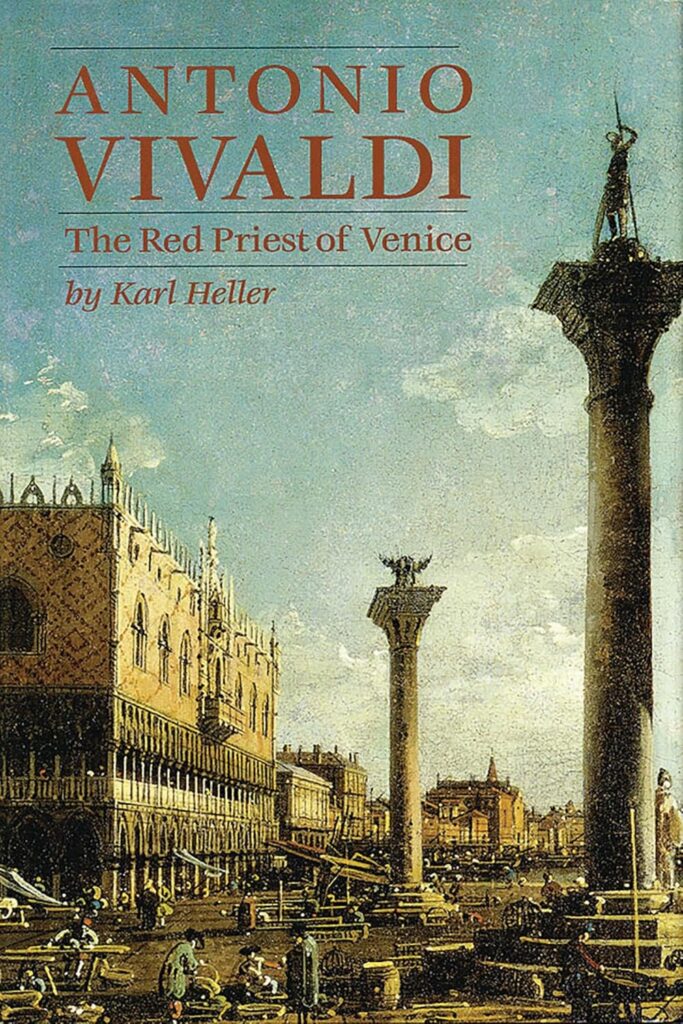
Antonio Vivaldi: The Red Priest of Venice by Karl Heller is a concise but authoritative scholarly biography of Antonio Vivaldi, written by one of the foremost specialists in Vivaldi research. The book is especially valued for its documentary rigor, its careful use of archival sources, and its role in correcting long-standing myths surrounding Vivaldi’s life and music.
The Author and His Authority
Karl Heller is best known as:
- a leading editor and contributor to the Vivaldi critical editions
- a major figure in the 20th-century rediscovery of Vivaldi
- a scholar deeply involved in manuscript studies, cataloguing, and source criticism
This background gives the book a solid factual foundation and a tone of measured historical sobriety.
Purpose and Approach
Heller’s aim is not to write a romantic or anecdotal biography, but to:
- reconstruct Vivaldi’s life from verifiable documents
- clarify his professional activities in Venice and beyond
- situate his music within Venetian institutional culture
- explain how Vivaldi functioned as composer, violinist, priest, and musical entrepreneur
The book deliberately avoids speculation and legend unless clearly identified as such.
The “Red Priest” Explained
Heller carefully explains the famous nickname:
- Vivaldi was ordained in 1703
- his red hair earned him the epithet “Il Prete Rosso”
- his limited celebration of Mass is examined without moral judgment, focusing instead on health issues and institutional realities
Rather than sensationalizing the priest–composer paradox, Heller presents it as typical of Venetian pragmatism.
Venice and the Ospedale della Pietà
A central section of the book is devoted to:
- the Ospedale della Pietà
- Vivaldi’s long and complex association with it
- the role of the orphaned girls as elite professional musicians
Heller shows how this institution shaped:
- Vivaldi’s instrumental style
- his prolific concerto output
- his experimental approach to form and color
Venice emerges not as a backdrop, but as a decisive structural force in Vivaldi’s career.
Opera, Travel, and Reputation
The book gives careful attention to:
- Vivaldi’s operatic ambitions
- his travels to Mantua, Rome, and other centers
- his relationships with singers, patrons, and impresarios
Heller avoids exaggeration, presenting Vivaldi as successful but unstable, admired in his prime yet increasingly marginalized as tastes changed.
Decline and Death
One of the book’s most sober chapters concerns:
- Vivaldi’s final years
- his move to Vienna
- his death in relative obscurity in 1741
Heller stresses that this decline was historically conditioned, not a moral or artistic failure, and typical of many composers whose style fell out of fashion.
Music and Style
While not a full analytical study, the book offers:
- clear explanations of Vivaldi’s formal innovations
- discussion of concerto types and vocal genres
- insight into his influence on Bach and later composers
The emphasis is on function, context, and output, rather than technical analysis.
Scholarly Value and Reception
This book is regarded as:
- reliable
- fact-driven
- essentially corrective
It complements larger studies (such as those by Michael Talbot) and is particularly useful as:
- an entry point for serious readers
- a reference biography
- a historically grounded alternative to romanticized accounts
Limitations
- relatively brief
- restrained narrative style
- minimal psychological speculation
These are deliberate scholarly choices, not weaknesses.
Conclusion
Karl Heller’s The Red Priest of Venice presents Vivaldi as a professional composer embedded in Venetian institutions, not as a caricature of genius or eccentricity. Its strength lies in clarity, accuracy, and historical balance, making it one of the most trustworthy short biographies of Vivaldi available.