Anton Bruckner, Rustic Genius by Werner Wolff
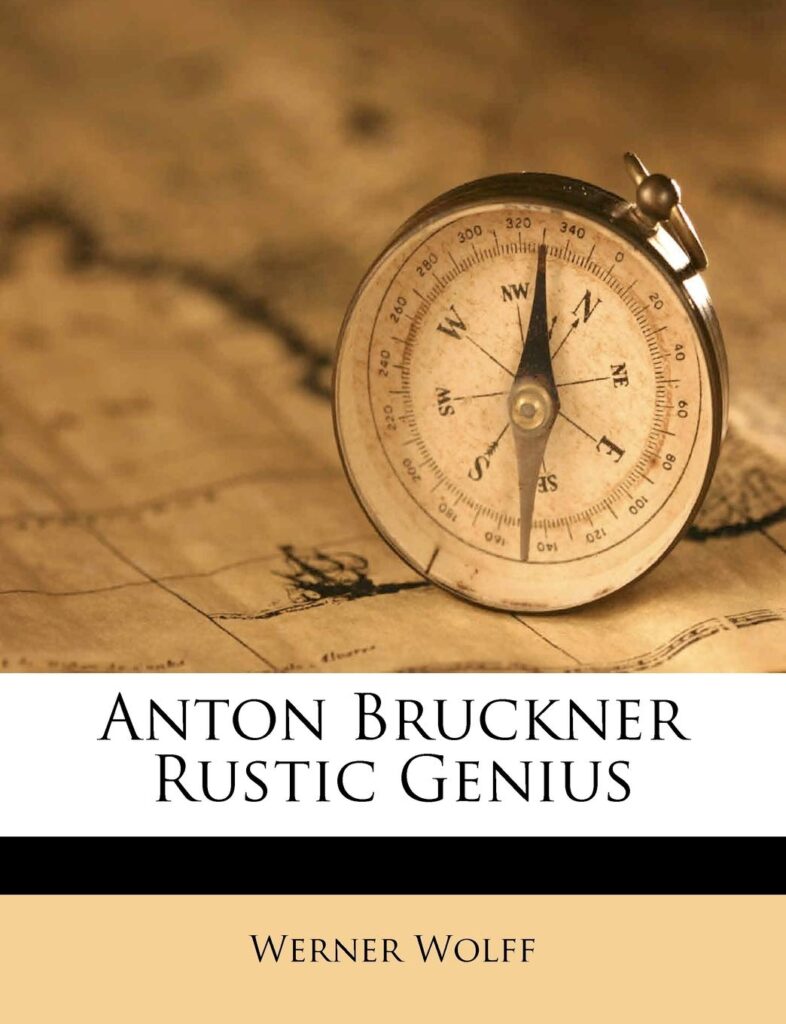
The conception of the book
Anton Bruckner: Rustic Genius is one of the earliest attempts in English to humanize and interpret Bruckner psychologically, rather than merely document his life. Written in a mid-20th-century idiom, the book reflects a moment when Bruckner was still widely misunderstood outside German-speaking countries and needed to be introduced as a personality as much as a composer.
Werner Wolff approaches Bruckner not as an abstract symphonic architect, but as a deeply provincial, emotionally vulnerable, and spiritually driven individual, whose creative power grew directly out of his rural background and inner conflicts.
“Rustic genius”: what Wolff means
The term “rustic” is central and deliberate. Wolff does not use it pejoratively, but descriptively, to underline:
- Bruckner’s peasant origins in Upper Austria
- His lifelong sense of social awkwardness in Vienna
- His instinctive, non-cosmopolitan worldview
- The contrast between monumental musical structures and a simple, often childlike personality
For Wolff, Bruckner’s genius is inseparable from this rusticity. The symphonies are presented as cathedrals built by a village believer, not salons crafted by an urban intellectual.
Psychological portrait
Unlike documentary biographies, Wolff is openly interpretive. He attempts to explain:
- Bruckner’s extreme self-doubt and need for validation
- His compulsive habits and numerical fixations
- His submissive behavior toward authority figures
- His fear of rejection and hunger for approval
These traits are linked to religious devotion, sexual repression, and social insecurity, sometimes in speculative ways typical of the period. While modern readers may find parts dated, the psychological insight is often intuitively persuasive, especially when read alongside primary sources.
Religion and mysticism
Wolff places Catholic faith at the very center of Bruckner’s being. He emphasizes:
- The formative role of St. Florian Abbey
- Bruckner’s relationship to the organ as a sacred instrument
- Prayer as a compositional and emotional refuge
- The symphonies as acts of devotion rather than aesthetic argument
In this view, Bruckner’s music does not seek to persuade or impress, but to affirm cosmic and spiritual order. Wolff’s prose here is often lyrical, even rhapsodic, reflecting his conviction that Bruckner’s art cannot be separated from belief.
Vienna and the sense of exile
Vienna appears in the book less as a cultural capital than as a hostile environment. Wolff vividly portrays:
- Bruckner as an outsider among urbane intellectuals
- The cruelty of critics and institutional opposition
- The composer’s inability to defend himself verbally or socially
This reinforces the image of Bruckner as a moral and spiritual exile, whose inner certainty clashed with a skeptical, aestheticized musical culture.
Strengths and limitations
Strengths
- Vivid, readable prose
- Strong psychological intuition
- Clear sense of Bruckner as a living human being
- Helped introduce Bruckner to English-speaking audiences
Limitations
- Speculative psychology by modern standards
- Limited use of documentary citation
- Occasional romanticization of “naïveté”
- Less precise on chronology and sources than later scholarship
Place in Bruckner literature
Anton Bruckner: Rustic Genius is best read not as a definitive biography, but as an interpretive portrait. It pairs especially well with:
- Documentary works (to ground the facts)
- Later analytical biographies (to refine perspective)
Its enduring value lies in reminding the reader that Bruckner’s music was created by a fragile, earnest, deeply human individual, not by an abstract symphonic machine.
Conclusion
Werner Wolff’s Anton Bruckner: Rustic Genius remains a sympathetic, if dated, classic—a book that helped shape the English-language image of Bruckner for decades. Its greatest achievement is not factual completeness, but empathic understanding: the insistence that Bruckner’s towering symphonies grew from humility, faith, and emotional exposure.