Alban Berg and His World, Edited by Christopher Hailey
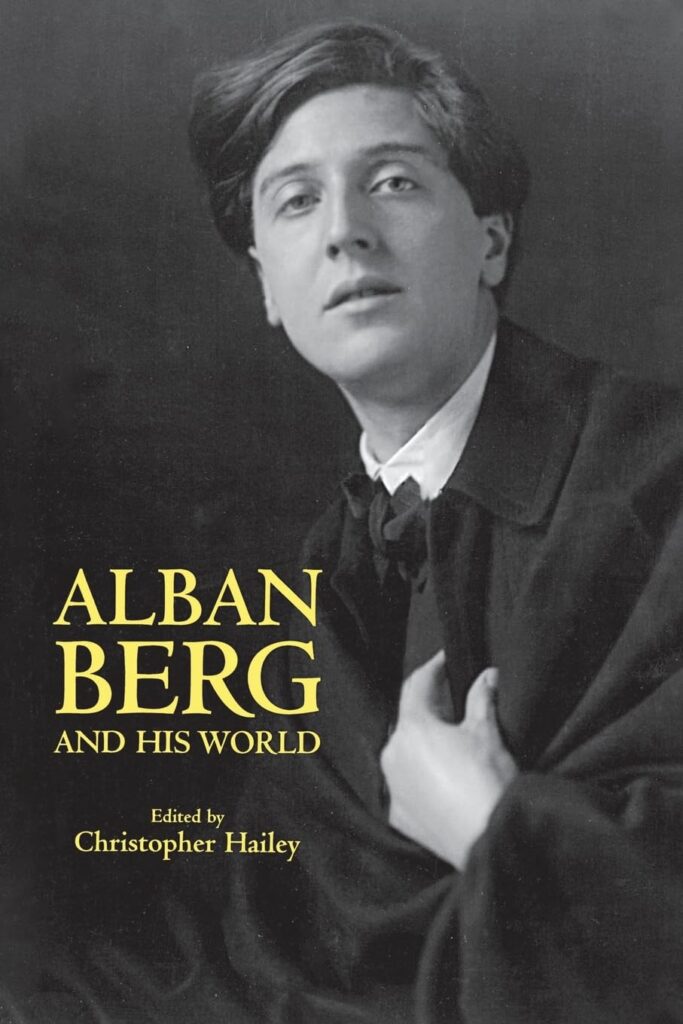
Alban Berg and His World is a major scholarly essay collection devoted to Alban Berg, published as part of the prestigious “His World” series by Princeton University Press. Rather than offering a linear biography, the volume reconstructs the cultural, intellectual, social, and aesthetic environment in which Berg lived and composed, placing his music within the fractured modernity of early 20th-century Vienna.
Concept and Editorial Approach
Under Christopher Hailey’s editorship, the book adopts a contextual and interdisciplinary perspective. Berg is not treated in isolation, but as a figure shaped by — and reacting to —:
- Viennese fin-de-siècle culture
- Expressionism and modernist literature
- psychoanalysis
- political collapse and social instability
- the Second Viennese School
The volume deliberately avoids a single narrative voice. Instead, it offers multiple scholarly viewpoints, creating a composite portrait of Berg as composer, intellectual, private individual, and historical witness.
Structure of the Volume
The book is typically organized into thematic sections, combining musicology, cultural history, and documentary material.
1. Vienna and Modernism
Essays explore Vienna as a city of contradictions: artistic brilliance alongside moral anxiety, decadence alongside discipline. Berg is situated within a culture shaped by Mahler, Freud, Klimt, Kraus, and the disintegration of Austro-Hungarian imperial identity.
2. Berg and Schoenberg
Several contributions examine Berg’s relationship with Arnold Schoenberg — not merely as teacher and pupil, but as aesthetic and ethical influence. Berg appears as the most emotionally expansive member of the Schoenberg circle, balancing structural rigor with lyric intensity.
3. Works and Aesthetic Position
Key works such as Wozzeck, Lulu, the Violin Concerto, and the Lyric Suite are examined not only analytically, but symbolically — as responses to trauma, sexuality, alienation, and memory. Essays emphasize Berg’s ability to humanize modernist technique.
4. Personal Life and Inner World
The volume does not ignore Berg’s private sphere:
- his emotional sensitivity
- his marriage to Helene Berg
- his fascination with numerology, secrecy, and encoded meaning
These aspects are treated with scholarly restraint, avoiding sensationalism while acknowledging their relevance to his music.
5. Documents and Reception
As with other volumes in the series, the book includes letters, contemporary criticism, and primary documents, illuminating how Berg was perceived by his contemporaries and how his reputation evolved after his death.
Scholarly Importance
Alban Berg and His World is valued for:
- its breadth of intellectual context
- its integration of music, literature, psychology, and history
- its avoidance of simplistic narratives about “atonality”
- its portrayal of Berg as the most humanly expressive modernist
The book is particularly effective in explaining why Berg’s music has retained emotional immediacy even for listeners resistant to early 20th-century modernism.
Who This Book Is For
- scholars and advanced students of 20th-century music
- readers interested in Vienna 1900
- musicians seeking contextual depth behind Berg’s scores
- readers who prefer cultural history over straight biography
It complements, rather than replaces, traditional biographies.
Critical Assessment
The volume is widely regarded as:
- authoritative
- intellectually rich
- indispensable for serious Berg studies
Its only limitation is inherent to essay collections: uneven density between chapters. But the overall coherence under Hailey’s editorship is strong.
Conclusion
Alban Berg and His World presents Berg not as an abstract modernist icon, but as a deeply responsive artist, whose music stands at the intersection of personal emotion and historical rupture. It is one of the most illuminating ways to understand how Berg’s world shaped his sound — and why that sound still speaks so powerfully today.