A History of opera – Milestones and Metamorphoses by Burton D. Fisher (Music Art Ebook)
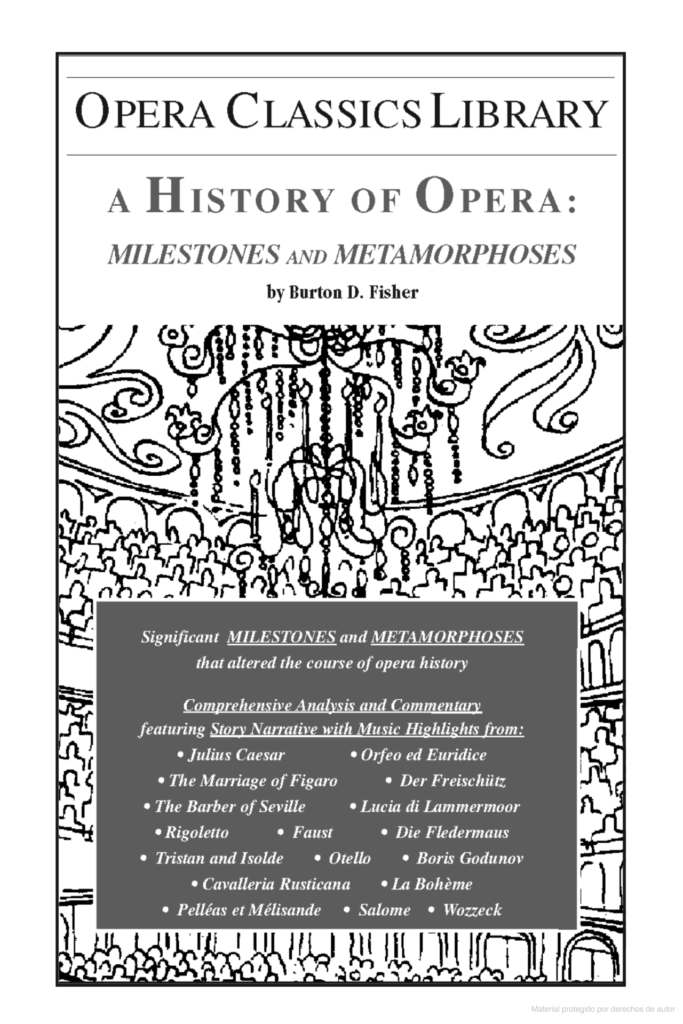
A History of Opera – Milestones and Metamorphoses presents opera not as a linear catalogue of composers and works, but as a living organism in constant transformation, shaped by changing aesthetics, social structures, theatrical technologies, and the evolving psychology of audiences. The very choice of the words milestones and metamorphoses signals the book’s intent: to trace decisive turning points while revealing how opera continually reinvents itself.
From its opening pages, the narrative rejects the idea of opera as a fixed tradition. Instead, it unfolds as a succession of experiments, each responding to the cultural tensions of its time. Opera emerges here not as an inevitable art form, but as a fragile and audacious invention—one that repeatedly risks collapse and renewal.
Origins: The Dream of Reviving Antiquity
The story begins in late Renaissance Italy, where humanists sought to resurrect the emotional power of ancient Greek drama. What they produced was something entirely new. Early opera appears in the book as an intellectual gamble, combining poetry, music, gesture, and spectacle into a unified dramatic experience. Figures such as Monteverdi are presented not as monuments, but as innovators navigating uncharted territory, constantly negotiating between expression and convention.
The book emphasizes how early opera was inseparable from court culture, patronage, and political display. Music drama was born not only from artistic ideals, but from power, prestige, and ceremonial necessity.
Opera as Public Spectacle
As opera moved from courts to public theatres, particularly in Venice, its identity changed radically. The narrative captures this shift as a true metamorphosis: opera becomes popular, commercial, and responsive to audience taste. Star singers, vocal virtuosity, and formulaic structures emerge not as decadence, but as adaptive strategies that allowed opera to survive and spread across Europe.
Here the book excels in showing how artistic compromise often fuels longevity. Opera’s history is presented not as a steady ascent, but as a series of negotiations between art and market.
Reform, Revolution, and Drama
The Enlightenment brings a new tension: the desire for truth, clarity, and dramatic coherence. Reform movements—most notably those associated with Gluck—are described as reactions against excess rather than radical breaks. Opera, once again, reshapes itself in response to philosophical ideals.
As the narrative progresses into the nineteenth century, opera becomes increasingly entangled with national identity, politics, and personal psychology. Romantic opera is portrayed as a medium of obsession, myth, and inner conflict, culminating in works that stretch the boundaries of time, harmony, and theatrical illusion.
The Wagnerian Turning Point
One of the central milestones of the book is the Wagnerian transformation. Rather than treating Wagner as an isolated genius, the author situates him within a broader crisis of form. Opera, by the mid-19th century, was struggling to reconcile spectacle with meaning. Wagner’s response—through music drama, leitmotivic continuity, and mythic narrative—is presented as both culmination and rupture.
Importantly, the book does not present Wagner as the inevitable future of opera, but as one possible answer among many, whose consequences were as problematic as they were influential.
Modernity and Fragmentation
Twentieth-century opera appears not as decline, but as diversification. The narrative explores how opera absorbs modernism, irony, psychological realism, and even anti-opera gestures. Tonality dissolves, narratives fracture, and opera becomes self-reflective, questioning its own legitimacy.
Rather than lamenting this fragmentation, the book frames it as opera’s latest metamorphosis—a sign that the genre remains alive precisely because it refuses to stabilize.
Why This Book Matters
A History of Opera – Milestones and Metamorphoses stands out for its conceptual coherence. It does not aim to be exhaustive; instead, it seeks to explain why opera changes when it does. Its narrative approach makes it particularly valuable for readers who already know the repertoire but wish to understand opera as a historical process rather than a museum tradition.
As a Music Art eBook, it also benefits from a visually enriched presentation, reinforcing the idea that opera has always been a total art form, inseparable from space, image, and gesture.
Final Perspective
This book leaves the reader with a clear impression: opera survives not by preserving itself unchanged, but by embracing transformation. Its history is not a straight line, but a spiral—returning to old questions with new answers. In that sense, the true subject of the book is not opera’s past, but its perpetual capacity for reinvention.