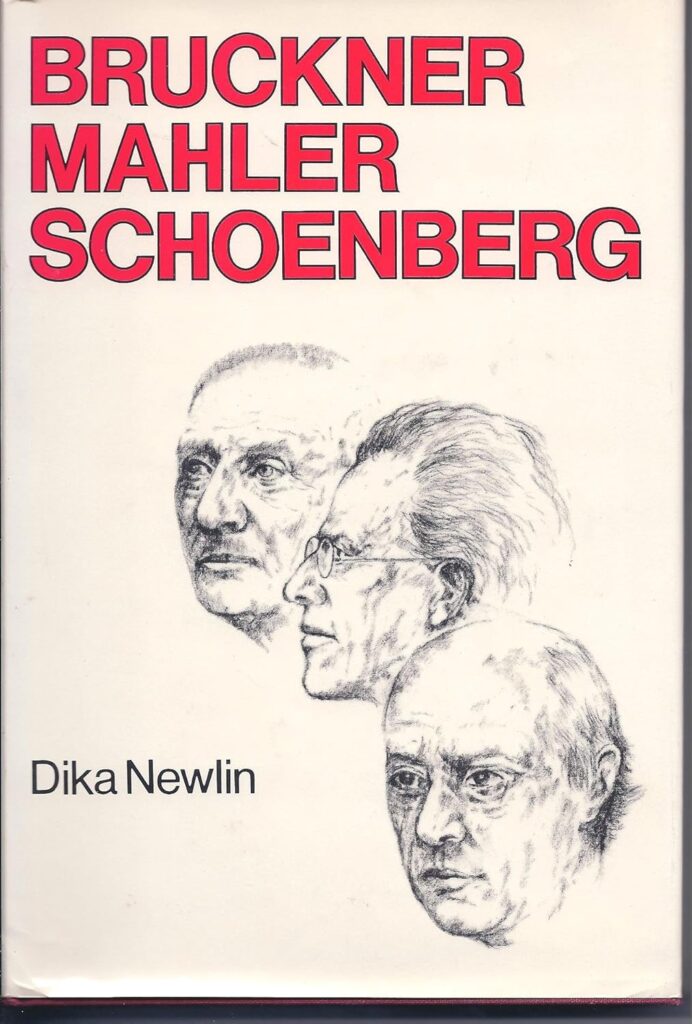
Bruckner – Mahler – Schoenberg by Nika Newlin
Scope and intellectual ambition
Bruckner – Mahler – Schoenberg by Nika Newlin is a conceptually ambitious study that traces a single symphonic–aesthetic lineage from late Romanticism to early musical modernism. Rather than treating these three composers as representatives of separate “schools,” Newlin presents them as successive stages of one continuous Viennese tradition, each responding to inherited problems of form, expression, and meaning.
The book’s central idea is clear and bold: Schoenberg is not a rupture from Bruckner and Mahler, but their historical consequence.
Method: tradition as evolution, not rupture
Newlin’s method is neither biographical nor narrowly analytical. Instead, she adopts a historical–aesthetic approach, focusing on:
- The evolution of large-scale musical form
- The changing function of tonality
- The shifting role of subjectivity and expression
- Vienna as a cultural and intellectual ecosystem
She argues that what appears as stylistic opposition—cathedral-like Bruckner, autobiographical Mahler, radical Schoenberg—is in fact a logical unfolding of unresolved tensions within the same tradition.
Bruckner: monument and stasis
In Newlin’s reading, Bruckner represents the last stable embodiment of symphonic monumentality:
- Tonality is firm and gravitational
- Form is expansive but hierarchically ordered
- Musical time feels ritualistic rather than narrative
Bruckner’s symphonies are presented as structures of belief, where coherence is guaranteed by faith—musical and metaphysical. Yet Newlin subtly suggests that this very stability contains the seeds of crisis, as form expands toward its own limits.
Mahler: crisis within tradition
Mahler occupies the pivotal position in the book. Newlin sees him as the composer who inherits Bruckner’s scale but fills it with psychological conflict:
- Tonality becomes unstable, expressive, ironic
- Form absorbs contradiction rather than resolving it
- The symphony becomes a confessional space
Mahler does not abandon tradition; he exposes its fragility from within. For Newlin, Mahler’s music demonstrates that the old symphonic language can no longer sustain certainty without fracture.
Schoenberg: necessity of transformation
Schoenberg appears not as a revolutionary iconoclast, but as a composer who accepts the implications of Mahler’s crisis:
- Tonality collapses under expressive pressure
- Motivic logic replaces tonal hierarchy
- Form becomes internally generated rather than inherited
Newlin is especially effective in arguing that atonality and twelve-tone thinking arise not from theoretical abstraction, but from ethical and expressive necessity—the same necessity that drove Mahler to the edge.
Vienna as the connective tissue
A major strength of the book is its treatment of Vienna as more than a backdrop:
- Shared institutions and audiences
- Overlapping pedagogical traditions
- Common aesthetic anxieties
- A culture negotiating the end of certainty
Newlin shows how these composers, despite personal and stylistic differences, participated in a shared cultural conversation about meaning, form, and expression at the turn of the century.
Strengths and limitations
Strengths
- Clear, elegant conceptual framework
- Persuasive historical continuity
- Balanced treatment of all three composers
- Early and influential challenge to “break-with-the-past” narratives
Limitations
- Limited technical musical analysis
- Less engagement with later manuscript and revision scholarship
- Assumes a reader already familiar with the repertoire
Nonetheless, its ideas remain remarkably durable.
Place in 20th-century musicology
Newlin’s book occupies an important historical position:
- Earlier than most post-war Mahler revival studies
- More integrative than composer-specific monographs
- Anticipates later views of modernism as evolution rather than revolt
It pairs especially well with Redlich’s Bruckner & Mahler and later Schoenberg studies that emphasize continuity over rupture.
Conclusion
Bruckner – Mahler – Schoenberg is a quietly radical book. Its lasting achievement is to show that musical modernism did not begin with rejection, but with inheritance pushed to breaking point. In Newlin’s vision, Schoenberg does not negate Bruckner’s cathedral—he builds its structure inward, where belief must be reinvented.