Recognition in Mozart’s Operas – Jessica Waldoff
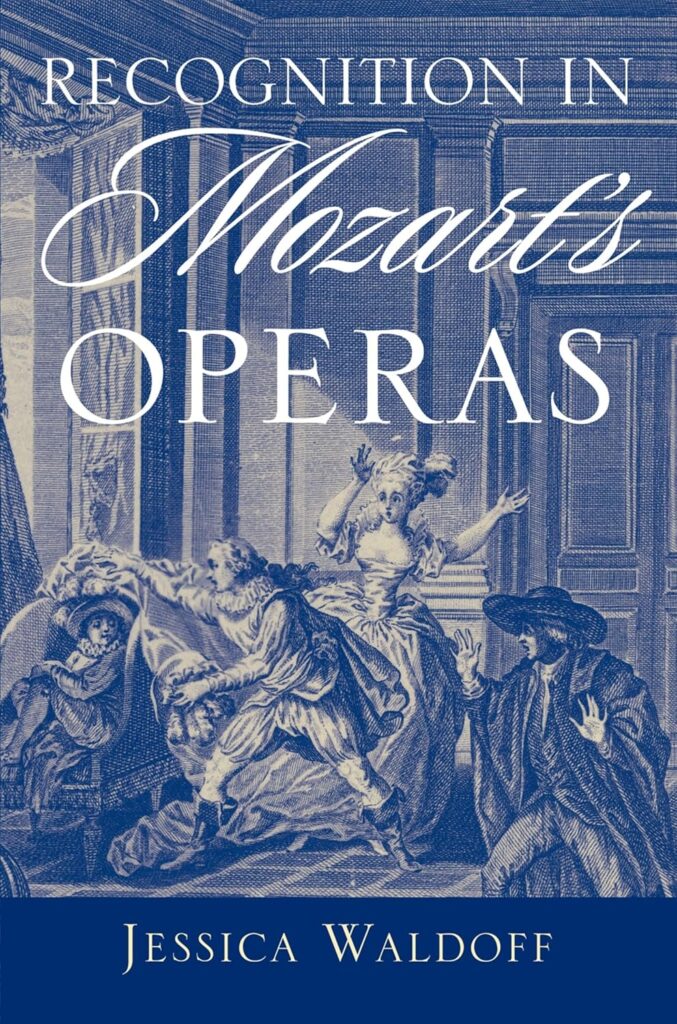
Recognition in Mozart’s Operas
by Jessica Waldoff
Scope and central idea
Recognition in Mozart’s Operas is a focused analytical monograph that examines one of the most powerful dramatic mechanisms in Mozart’s stage works: recognition—moments when characters discover identities, truths, relationships, or moral realities that had previously been concealed or misunderstood. Waldoff approaches recognition not as a mere plot device, but as a structural, musical, and ethical engine that shapes Mozart’s operatic dramaturgy.
The book argues that Mozart consistently integrates recognition into musical form, using harmony, orchestration, texture, and ensemble writing to articulate psychological awakening and social reordering.
Conceptual framework
Waldoff grounds her study in the classical notion of anagnorisis (from Aristotle), but adapts it to late-18th-century opera, where recognition often unfolds gradually rather than instantaneously. In Mozart, recognition may be:
- personal (self-knowledge),
- interpersonal (family, lovers, social ties),
- or moral (ethical awareness and accountability).
Crucially, Waldoff shows that Mozart’s recognitions are rarely purely verbal; they are musically enacted, often preceding or even contradicting what characters say.
Operas and case studies
The book focuses primarily on the Da Ponte operas—Le nozze di Figaro, Don Giovanni, and Così fan tutte—while also engaging with Idomeneo and Die Zauberflöte.
Key insights include:
- In Figaro, recognition is collective and social: identities are revealed through ensembles, mirroring the restoration (and critique) of social order.
- In Don Giovanni, recognition is moral and asymmetrical: some characters recognize truth too late—or not at all—while the music exposes realities the protagonist refuses to acknowledge.
- In Così fan tutte, recognition is destabilizing: characters learn truths that cannot be unlearned, and the music resists any simple moral closure.
- In Die Zauberflöte, recognition is ritualized and symbolic, aligning personal enlightenment with communal initiation.
Music as agent of recognition
One of Waldoff’s most original contributions is her demonstration that musical processes themselves generate recognition. She analyzes:
- harmonic returns that signal memory and revelation,
- orchestral color as a marker of concealed knowledge,
- ensemble layering as a sonic analogue of simultaneous awareness and misunderstanding.
Recognition, in this reading, is not an event but a process unfolding in time, often reaching clarity only at cadential or formal junctures.
Dramatic and ethical implications
Waldoff places recognition at the heart of Mozart’s operatic humanism. These moments force characters—and audiences—to confront:
- responsibility,
- forgiveness,
- limits of knowledge,
- and the tension between social roles and inner truth.
Mozart’s operas thus become dramas not merely of action, but of understanding, where music mediates between emotion and reason.
Style and scholarly value
The prose is precise, analytically rigorous, and musically grounded, assuming readers with some familiarity with score reading and operatic form. Musical examples are used judiciously to support arguments rather than overwhelm them.
The book is particularly valuable for:
- Mozart scholars,
- opera dramaturgs and directors,
- performers interested in dramatic meaning beyond vocal line,
- readers exploring the intersection of music theory and theatrical narrative.
Publication data
- First publication: 2010
- Publisher: Oxford University Press (Oxford & New York)
- Series context: Academic musicology / opera studies
- Format: Hardcover (initial), later paperback and digital editions
- Textual status: No substantially revised later edition; the book remains a standard reference for Mozart operatic dramaturgy.
Assessment
Recognition in Mozart’s Operas stands as one of the most conceptually elegant studies of Mozartian opera in recent decades. By treating recognition as a musical-dramatic process rather than a narrative convenience, Jessica Waldoff reveals a unifying principle that links Mozart’s comic, serious, and symbolic operas into a coherent dramatic vision.