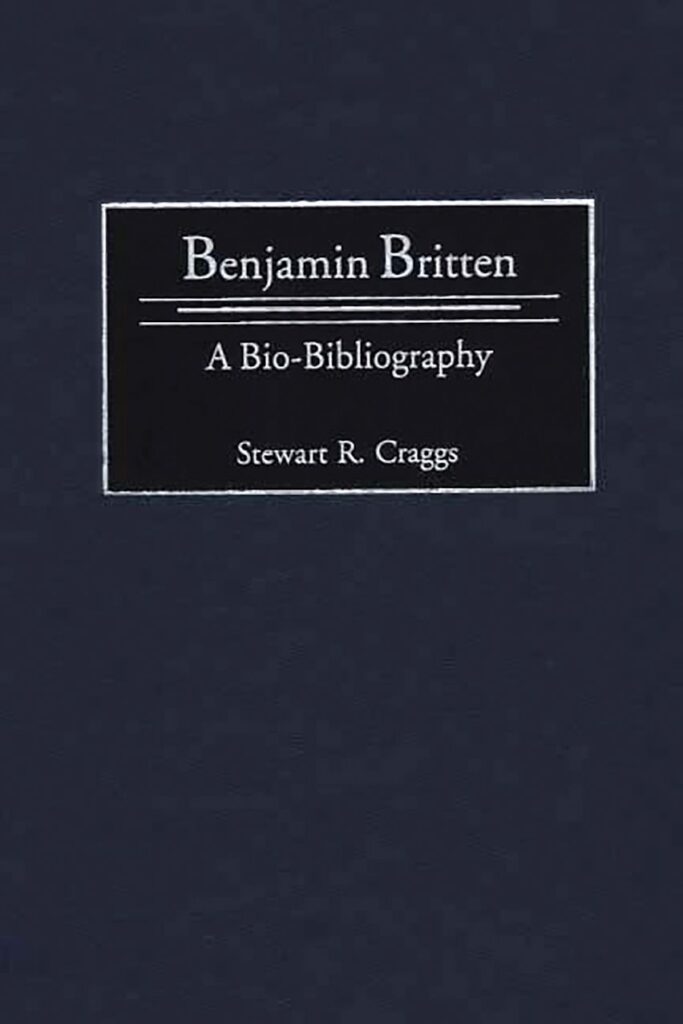
Benjamin Britten A Bio-Bibliography – Stewart R. Craggs
Nature and purpose of the book
Benjamin Britten: A Bio-Bibliography is not a narrative biography in the conventional sense, but a scholarly reference work designed to document, with maximum precision, both Britten’s life events and the complete documentary footprint of his career. Stewart R. Craggs—one of the most meticulous Britten scholars—conceived the volume as a research tool, indispensable for musicologists, librarians, performers, and serious readers.
The book belongs to the tradition of Anglo-American bio-bibliographical handbooks, where factual reliability, chronology, and completeness take precedence over interpretation or literary style.
Structure and content
The volume is typically divided into two large, complementary sections:
1. Biographical chronology
Craggs presents Britten’s life in a strictly chronological framework, year by year and often month by month. This section includes:
- education and early formation
- compositional milestones
- premieres and first performances
- collaborations (notably with Peter Pears)
- travels, commissions, and institutional roles
- health issues and late-life decline
The tone is neutral and documentary, avoiding speculation or psychological interpretation. The value lies in accuracy: dates, places, names, and factual context are carefully verified.
2. Bibliography and documentation
The second major section constitutes one of the book’s greatest strengths. It offers an extensive, systematically organized bibliography, covering:
- books and articles about Britten
- contemporary reviews
- interviews and broadcasts
- program notes and essays by Britten
- obituaries and memorial texts
Each entry is clearly referenced, making the book a gateway to the entire Britten literature up to the date of publication.
Methodological approach
Craggs’s approach is deliberately non-interpretive. Unlike biographies by Humphrey Carpenter or Paul Kildea, this book does not attempt to explain Britten’s psychology, sexuality, or moral worldview. Instead, it provides the raw material upon which such interpretations can responsibly be built.
In this sense, the book functions as:
- a factual backbone for Britten studies
- a verification tool for dates and sources
- a bibliographical compass for further research
Scholarly significance
The importance of Benjamin Britten: A Bio-Bibliography lies in its authority and reliability. It is frequently cited in:
- academic articles
- critical editions
- liner notes and program essays
- doctoral dissertations
For scholars, it serves a role comparable to a thematic catalogue, even though its scope is broader and documentary rather than analytical.
Limitations (by design)
Because of its reference nature:
- it is not intended for continuous reading
- it lacks narrative flow
- it avoids aesthetic or ideological discussion
These are not shortcomings but conscious editorial choices, aligned with the book’s function.
Publication data
- First publication: 1998
- Publisher: Greenwood Press (Westport, Connecticut & London)
- Series: Bio-Bibliographies in Music
- Format: Hardcover
- Later editions: No substantially revised new edition; the book remains cited as the standard bibliographical reference for Britten studies up to the late 20th century.
Assessment
Benjamin Britten: A Bio-Bibliography is an essential infrastructural work in Britten scholarship. It does not interpret Britten—it documents him. For anyone writing, researching, or publishing seriously on Britten, it is not optional but foundational.