Opera, A History – Christopher Headington
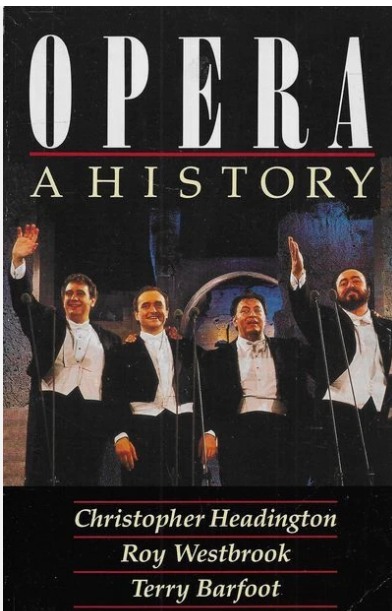
Opera, A History by Christopher Headington is a clear, cultivated, and quietly authoritative survey of opera’s development, written by a scholar who understood that opera history must be told not only through facts and dates, but through style, theatrical instinct, and cultural context.
Headington does not treat opera as a museum sequence of masterpieces. Instead, he presents it as a continuous dramatic tradition, shaped by changing ideas about voice, theatre, society, and musical language.
Conception and Writing
- Date of composition: late 1970s
- Written at a moment when:
- traditional narrative histories of music were still central
- but newer cultural and theatrical perspectives were beginning to influence musicology
Headington’s aim was synthesis rather than polemic. He sought to explain how opera evolved, not to argue for radical reinterpretations. The result is a book that balances historical continuity with stylistic change, making it particularly readable and pedagogically effective.
First Publication
- First publication: 1978
- Publisher: The Bodley Head
- Place of publication: London
The Bodley Head’s involvement situates the book within the tradition of serious but accessible British cultural publishing, intended for educated general readers, students, and opera lovers rather than specialists alone.
Editions and Reprints
- Original edition: 1978 (hardcover)
- Later reprints: 1980s–1990s
- Paperback editions: issued for academic and general readership
There is no substantially revised second edition. The book stands as a coherent historical statement of its time, which partly explains its enduring clarity and internal consistency.
Scope and Structure
The narrative proceeds broadly chronologically, covering:
- the origins of opera in late Renaissance Italy
- the emergence of public opera and international styles
- the classical balance of drama and form
- the expansion of romantic opera and national traditions
- Wagner and the transformation of music drama
- the challenges and diversifications of 20th-century opera
Headington avoids exhaustive catalogues. Instead, he focuses on representative works, stylistic turning points, and theatrical logic, allowing the reader to grasp why opera changes when it does.
Method and Perspective
What distinguishes this book is its sense of proportion. Headington:
- resists hero worship
- avoids reducing opera to purely social history
- keeps music and drama in constant dialogue
Opera is treated neither as abstract musical form nor as mere spectacle, but as a hybrid art whose identity depends on balance—between voice and orchestra, drama and structure, innovation and tradition.
Tone and Style
The prose is:
- elegant and restrained
- confident without being dogmatic
- informative without becoming technical
This is British musicological writing at its most lucid: measured, explanatory, and quietly persuasive.
Why the Book Matters
Opera, A History has long been valued as:
- an introductory university text
- a reliable overview for serious opera lovers
- a counterweight to more ideological or polemical histories
Its strength lies in its narrative coherence. Readers come away not merely informed, but oriented—able to place individual operas and composers within a larger historical flow.
Bibliographic Summary
- Author: Christopher Headington
- Title: Opera, A History
- Composition: c. mid–late 1970s
- First publication: 1978
- Publisher: The Bodley Head (London)
- Editions: original hardcover; later reprints and paperback editions
- Genre: general opera history / narrative survey
Final Perspective
Headington’s book belongs to a lineage of civilised, humane opera histories—works that seek to educate without intimidating and to explain without oversimplifying. While later scholarship has expanded and diversified the field, Opera, A History remains a model of clarity and balance, especially valuable for readers who want to understand opera as a historical continuum rather than a collection of isolated monuments.