Beethoven, The Universal Composer – Edmund Morris
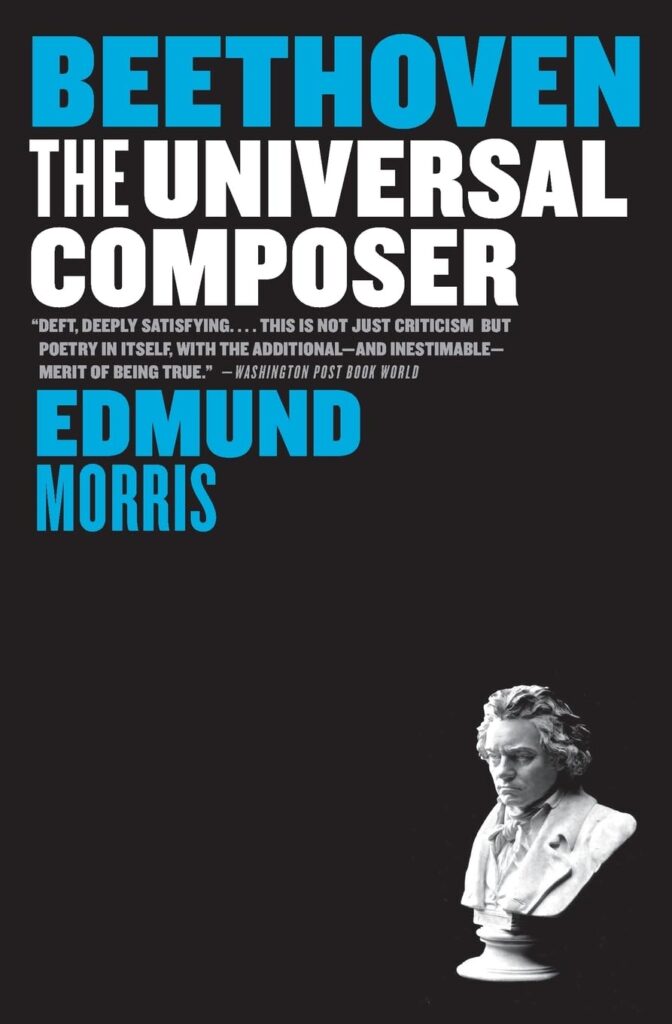
Publication history
- First edition (hardcover): 2005, published in the United States by HarperCollins / Atlas Books
- Paperback edition: February 9, 2010, Harper Perennial
- E-book edition: October 13, 2009, HarperCollins
Depending on the edition, the book runs to approximately 240–260 pages. It was conceived as a concise interpretive biography, not a comprehensive scholarly life.
The Author: Edmund Morris
Full name: Arthur Edmund Morris
Born: May 27, 1940, Nairobi, Kenya
Died: May 24, 2019, United States
Edmund Morris, celebrated for his literary biographies of figures like Theodore Roosevelt, turns here to Ludwig van Beethoven, offering a compact, elegant, and interpretive portrait rather than an archival monument. The book aims to explain why Beethoven’s music feels universal—cutting across cultures, eras, and ideologies—by tracing how his personality, ideals, and historical moment fused into a singular artistic voice.
Concept and Scope
Morris does not attempt a comprehensive year-by-year chronicle. Instead, he frames Beethoven as a moral and expressive force, a composer whose works articulate human struggle, defiance, tenderness, and transcendence. The narrative moves swiftly through the life while pausing on decisive psychological and artistic inflection points—youthful ambition in Bonn and Vienna, the shock of deafness, and the late style’s metaphysical reach.
Portrait of Beethoven
The Beethoven who emerges is fiercely independent, politically alert to Enlightenment ideals, emotionally volatile, and uncompromising about artistic truth. Morris underscores the composer’s radical redefinition of the artist’s role: no longer servant to courtly taste, but an autonomous creator addressing humanity at large. Deafness is treated less as tragedy than as a catalyst for inward concentration and formal daring.
Music as Universal Language
Rather than technical analysis, Morris writes about what the music does to listeners. Symphonies, sonatas, and quartets are presented as acts of communication, shaping collective ideas of heroism, freedom, intimacy, and reconciliation. Beethoven’s universality, in this telling, lies in his ability to encode private emotion into public form—music that feels both confessional and monumental.
Style and Readership
The prose is lucid, refined, and literary, accessible to general readers while remaining respectful of musical substance. Specialists may note the absence of deep score analysis or new documentary discoveries, but that is by design: this is a cultural essay in biographical form, not a scholarly reference work.
Critical Reception and Value
The book has been praised for its clarity, insight, and narrative poise, especially as an introduction or a reflective companion to listening. Its limitation—lightness on archival depth—is also its strength: Morris restores Beethoven to the realm of ideas and lived experience, explaining not how the music is made, but why it continues to matter.
In short
Beethoven: The Universal Composer is best read as a meditative biography—a concise, intelligent exploration of how one composer came to speak for humanity at large. Ideal for readers seeking meaning, context, and perspective, rather than exhaustive documentation.