Puccini – His Life and Works – Julian Budden
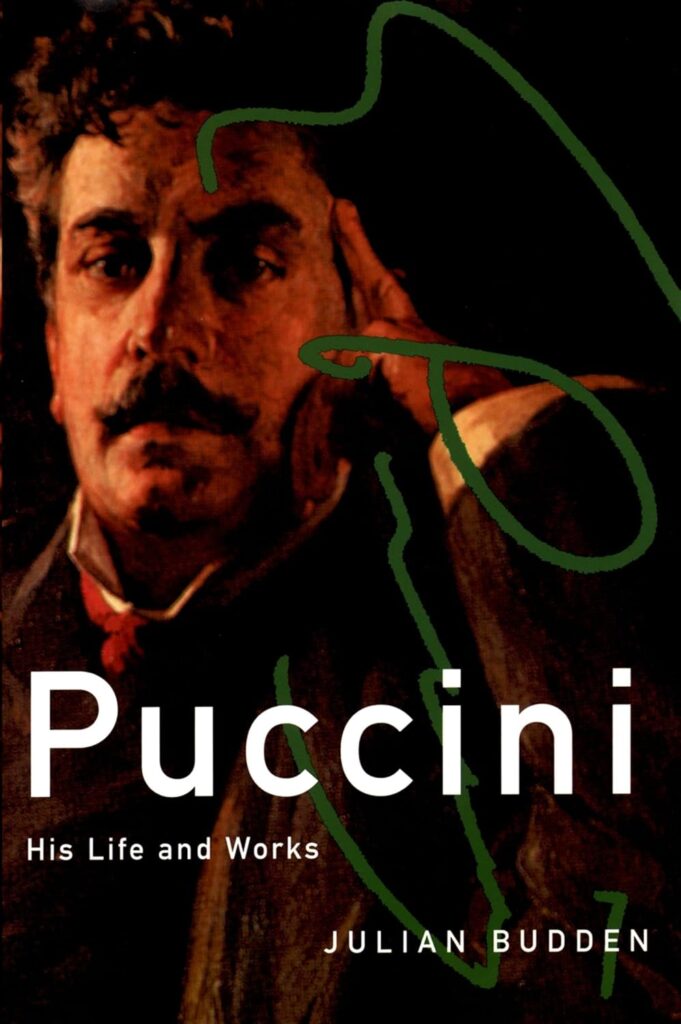
Julian Budden’s Puccini – His Life and Works is widely regarded as the most authoritative, balanced, and musically informed single-volume study of Giacomo Puccini available in English. First published in 2002 (with later reprints), it represents the culmination of Budden’s lifelong engagement with Italian opera and stands alongside his monumental work on Verdi as a model of serious operatic scholarship written with clarity and elegance.
1. The Author and His Authority
Julian Budden (1924–2017) was not merely a biographer but one of the foremost Anglo-Saxon scholars of Italian opera. His three-volume The Operas of Verdi had already established him as a leading authority on nineteenth-century Italian musical drama. When Budden turned to Puccini, he brought with him:
- deep command of Italian operatic tradition
- exceptional skill in score analysis
- long familiarity with archival sources, letters, and production history
- a rare ability to unite musical, dramatic, and biographical perspectives
This makes the book far more than a narrative life story: it is a critical study of Puccini as a composer of music drama.
2. Structure and Scope of the Book
The book is organized chronologically, but its real backbone is opera by opera analysis, each work placed firmly within Puccini’s personal, artistic, and historical context.
Budden covers:
- Puccini’s family background in Lucca, rooted in church music
- his formative years in Milan, including study at the Conservatorio
- the decisive influence of Giulio Ricordi
- Puccini’s evolving relationship with verismo, which Budden treats with nuance rather than cliché
- the genesis, composition, revisions, premieres, and reception of every major opera, from Le Villi to Turandot
- Puccini’s private life, including his complex emotional world, without sensationalism
The book ends with a sober, deeply informed discussion of Turandot, its unfinished state, and the aesthetic questions surrounding Alfano’s completion.
3. Musical and Dramatic Analysis
One of the book’s greatest strengths is Budden’s ability to explain how Puccini’s music works—dramatically, harmonically, orchestrally—without technical obscurity.
He gives particular attention to:
- Puccini’s orchestration, showing how it becomes increasingly symphonic and psychologically precise
- the use of leitmotivic technique, treated as flexible and expressive rather than Wagnerian dogma
- Puccini’s mastery of timing, pacing, and theatrical instinct
- the balance between melody and dramatic continuity
- Puccini’s subtle harmonic language, especially in Tosca, La fanciulla del West, and Il trittico
Budden consistently argues—convincingly—that Puccini was far more modern, experimental, and intellectually alert than earlier critics allowed.
4. Puccini Reassessed
A central aim of the book is to correct long-standing distortions in Puccini’s critical reception.
Budden firmly but calmly dismantles:
- the idea of Puccini as merely a “melodist”
- accusations of emotional manipulation
- the notion that Puccini lacked structural discipline
- simplistic readings of Puccini as a conservative composer opposed to modernism
Instead, Budden presents Puccini as a composer acutely aware of European musical developments, including Debussy, Strauss, and even early modernism, while remaining deeply Italian in dramatic instinct.
5. Style and Readability
Despite its scholarly depth, the book is exceptionally readable. Budden writes in a clear, cultivated prose style, avoiding jargon and polemic. The tone is:
- measured
- judicious
- sympathetic without being apologetic
- critical without being hostile
This makes the book suitable both for serious scholars and for well-informed opera lovers.
6. Critical Reception and Legacy
Since its publication, Puccini – His Life and Works has become:
- a standard reference in English-language Puccini studies
- a frequent citation in academic writing
- a recommended core text in conservatories and opera courses
While later research has added detail in specific areas (letters, staging history, source criticism), no subsequent single volume has displaced Budden’s book as the most reliable synthesis.
Overall Assessment
Strengths
- authoritative scholarship
- superb musical-dramatic analysis
- balanced biographical treatment
- clarity and elegance of style
Limitations
- less emphasis on sociological or gender-theory readings (by design)
- focuses primarily on the operas rather than peripheral works
Final Verdict
Puccini – His Life and Works by Julian Budden remains the definitive English-language study of Puccini, indispensable for anyone seeking to understand not only who Puccini was, but why his operas work so powerfully on the stage.